

Table of Contents
- Assess Resident Needs and Expected Gym Usage
- Plan Your Multifamily Fitness Center Design Around Available Space
- Select Apartment Gym Equipment for Your Residents
- Create Your Multifamily Gym Equipment Checklist
- Choose Apartment Gym Flooring That Performs
- Plan Layout, Circulation, and Equipment Spacing
- Set Your Budget and Prioritize Purchases
- Ensure Safety and Accessibility for All Users
- Frequently Asked Questions
Last Updated: October 11, 2026
Assess Resident Needs and Expected Gym Usage
Planning gym for multifamily buildings starts with understanding who will use it and how often.
Survey residents directly about equipment preferences, workout types, and preferred times. This data shapes your equipment mix, space allocation, and staffing decisions.
Unstaffed gyms require intuitive, durable, low-maintenance equipment. Staffed facilities can accommodate more complex machines and offer form guidance.
Plan Your Multifamily Fitness Center Design Around Available Space
Space is your primary constraint when planning gym for multifamily buildings. Measure your available area and account for circulation pathways residents need to move safely.
Determine Square Footage Requirements
Properties with fewer than 100 units need 800-1,200 sq. ft.; 100-300 units need 1,200-2,000 sq. ft.; 300+ units need 2,000-3,500 sq. ft. For smaller spaces, prioritize multi-use equipment like multi-station strength systems that deliver multiple exercises from one footprint.

Create Activity Zones for Different Workout Types
Divide your space into distinct zones: cardio, strength, and functional training. This prevents congestion and improves safety.
Position cardio near windows for natural light, strength equipment in the center with mirrors, and functional training in open areas. This layout improves ventilation and traffic flow.
Select Apartment Gym Equipment for Your Residents
Match equipment to your resident profile and available space. Generic recommendations often miss the mark.
Balance Cardio and Strength Training Options
Allocate roughly 40% of space and budget to cardio, 50% to strength training, and 10% to functional or recovery equipment.
For cardio, include equipment that requires minimal instruction: treadmills, ellipticals, and stationary bikes.
Strength training should include free weights, machines, and functional equipment. Free weights (dumbbells and barbells) appeal to experienced lifters and allow for endless exercise variety.
Prioritize Intuitive, Low-Maintenance Equipment
Equipment must be self-explanatory with large, readable labels. Commercial-grade equipment costs more upfront but lasts longer. Ask manufacturers about maintenance schedules and parts availability.
Low-maintenance equipment typically features sealed bearings, reinforced joints, and corrosion-resistant finishes. Rubber-coated dumbbells protect flooring and reduce noise compared with bare metal. The Anatomy Fitness Hex Rubber Dumbbell Sets include both 5-50 lb and 5-100 lb options with ergonomic handles and hex heads that prevent rolling, practical details that reduce damage and improve safety.

Create Your Multifamily Gym Equipment Checklist
Use this checklist to ensure you've covered all the essentials for your multifamily fitness center. Adjust quantities based on your space and resident count.
| Equipment Category | Recommended Items | Purpose |
|---|---|---|
| Cardio | 2-4 treadmills, 2-3 ellipticals, 2-3 stationary bikes | Variety for different preferences and impact levels |
| Free Weights | Dumbbell set (5-50 lb or 5-100 lb), barbell with plates, kettlebells | Progressive strength training and functional work |
| Strength Machines | Multi-station cable system or 2-3 single-stack machines | Guided movement for beginners and intermediate users |
| Functional Training | TRX straps, resistance bands, medicine balls, foam rollers | Recovery and functional movement |
| Storage | Dumbbell rack, barbell storage, equipment organizers | Safety and organization |
| Flooring | Performance athletic flooring | Protection, sound reduction, and durability |
This checklist covers the fundamentals. Adjust based on resident feedback and your available space.

Choose Apartment Gym Flooring That Performs
Flooring is often overlooked but critical for safety, durability, and resident experience. Poor flooring leads to noise complaints, equipment damage, and potential liability if someone slips or falls.
Performance athletic flooring absorbs impact, reduces noise, and provides appropriate friction for training.
Rubber flooring is durable and excellent for noise reduction, but some residents find it institutional.
Plan Layout, Circulation, and Equipment Spacing
Equipment arrangement determines whether your gym feels safe or cramped. Layout affects ventilation, noise, and lighting, all interconnected challenges.
Design Clear Pathways and Safety Zones
Maintain at least 3 feet of clear space around equipment, 2 feet between cardio machines, and 4 feet around free weights for safe movement and spotting.
Use a U-shaped or loop layout so residents move through logically without backtracking. This improves sightlines and safety.
Avoid dead zones by positioning tall equipment away from corners. Use mirrors opposite strength equipment and arrange machines in open rows or clusters for full visibility.
Account for Ventilation as a Core Design Constraint
Fitness spaces require 8-10 air changes per hour (ACH), compared with 6 ACH for offices.
If undersized, upgrade the central system, add a dedicated mini-split or supplemental unit, or install ceiling fans.
Position intake vents near the entrance and exhaust vents at the far end to create natural flow. Avoid placing equipment in front of vents.
Manage Acoustics to Protect Neighboring Residents
Noise is a top complaint about on-site gyms. Performance flooring with a resilient rubber base absorbs impact noise.
Machines with sealed bearings and soft-close systems reduce noise. Rubber-coated dumbbells and bumper plates absorb impact better than bare metal.
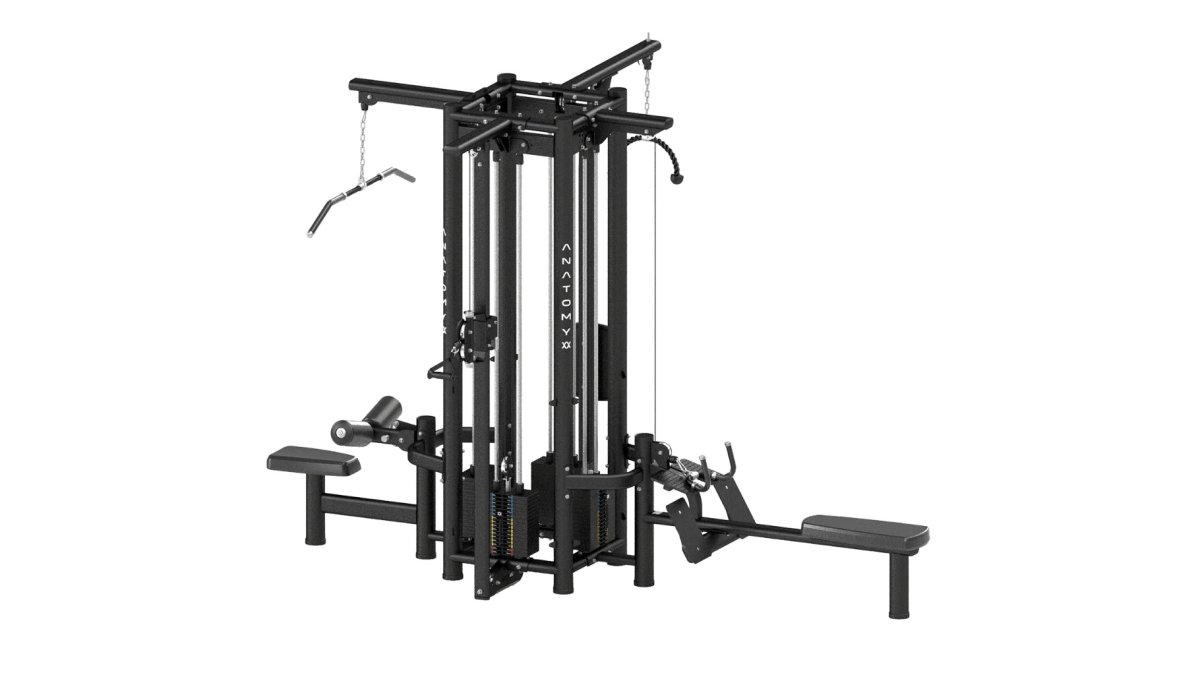
FLEXORA 4-Stack Multi Station | Anatomy Fitness →
Position free-weight areas away from shared walls. If noise-sensitive, add acoustic treatments or choose cable machines over free weights. Maintain cardio machines to prevent squeaking.
Design Lighting for Safety and Atmosphere
Maintain at least 50 foot-candles throughout. Use LED panels at 4000K (neutral white) installed evenly across the ceiling. Add task lighting on mirrors and accent lighting for ambiance. Dimmers and motion sensors are optional but useful.
Integrate Layout, Ventilation, Acoustics, and Lighting
These four elements are interdependent. A layout that maximizes sightlines but blocks ventilation vents creates dead zones. Acoustic treatments that absorb sound also absorb light, making the space feel darker.
Sketch your layout with equipment placement and sightlines. Map ventilation to avoid blocked airflow. Position noise sources away from shared walls. Plan lighting to eliminate dark corners.
Set Your Budget and Prioritize Purchases
Prioritize strategically. Lifecycle costs, maintenance, repairs, utilities, and warranties, often exceed purchase price over 5-10 years.
Calculate Total Cost of Ownership, Not Just Purchase Price
A treadmill's 5-year total cost of ownership (purchase plus maintenance, electricity, parts, and warranty) is roughly double the purchase price.
Free weights have low lifecycle costs, total 5-year cost is close to purchase price.
Ask manufacturers for maintenance schedules, warranty details, parts availability, expected lifespan, and electricity consumption. This helps you compare true cost.
Budget for Utilities and Infrastructure
A gym with multiple cardio machines might draw 8-12 kW during peak use. Estimate annual electricity costs for cardio ($400-$800/machine), cable machines ($100-$300/machine), and lighting/ventilation. Budget for ventilation upgrades if needed.
Plan for Replacement Cycles and Warranty Strategy
Commercial machines last 7-10 years. Typical replacements: treadmill belts every 2-3 years, motors every 5-7 years, cable machine cables every 3-5 years. Most warranties cover 2-3 years; extended warranties cost 15-25% of equipment price.
For high-use equipment, extended warranties often pay for themselves. For low-use equipment, standard warranties suffice. Always ask what's covered, some exclude wear items like belts and bearings.
Phase Your Purchases Strategically
Phase purchases to spread costs and learn from usage patterns. Phase 1: flooring, cardio, dumbbells, one cable system. Phase 2: additional cardio, barbells, kettlebells, functional equipment. Phase 3: recovery equipment and specialty machines based on feedback. This prevents costly mistakes.
Build a Maintenance and Replacement Reserve
Set aside 10-15% of annual operating budget for maintenance and replacement. Track costs and usage patterns to guide future purchases and avoid underutilized equipment.
Work with Vendors on Financing and Support
Revive and Lift offers flexible financing through Affirm and Shop Pay, and our commercial team can help you plan equipment purchases, request project quotes, and structure phased purchases to fit your budget.
When evaluating vendors, ask about:
- Financing options: Lease, rent-to-own, or purchase with deferred payments
- Volume discounts: Buying multiple machines at once often qualifies for 10-20% discounts
- Delivery and assembly: Who handles installation, and are they insured and experienced with multifamily properties?
- Ongoing support: Do they offer maintenance plans, parts availability, or technical support?
- Trade-in programs: Can you trade in old equipment for credit toward new purchases?
A vendor who understands multifamily properties and can support you through phasing, maintenance, and eventual replacement is worth more than the lowest price. Explore our commercial gym equipment collection and contact us for a consultation on planning your multifamily fitness center with a realistic budget and lifecycle cost strategy.
Ensure Safety and Accessibility for All Users
Include adjustable equipment and clear signage with images. Post emergency contact information and keep a first-aid kit.
Planning gym for multifamily buildings requires balancing resident needs, available space, equipment selection, and budget. Start by surveying your residents to understand their fitness preferences.
At Revive and Lift, we work with multifamily property managers to plan fitness amenities that residents actually use.
Frequently Asked Questions
How much space do you need for a multifamily building gym?
A basic apartment gym typically requires 400-800 square feet to accommodate cardio equipment, strength machines, free weights, and functional training zones. Smaller properties may start with 300 square feet for essential equipment; larger communities with higher resident density benefit from 1,000+ square feet to reduce wait times and support varied workout styles. The ideal size depends on your unit count, expected utilization rates, and the mix of equipment you plan to install.
What equipment should an apartment building gym include?
A well-rounded apartment gym typically includes 2-4 cardio machines (ellipticals, treadmills, or stationary bikes), a multi-stack strength machine for upper and lower body exercises, dumbbells ranging from 5-50 lbs, a dumbbell rack for storage, and functional training space for stretching and recovery. Start with versatile, durable equipment that serves a broad range of fitness levels and requires minimal maintenance. The FLEXORA 4-Stack Multi Station from Anatomy Fitness, for example, delivers multiple exercise stations from one footprint, making it efficient for space-conscious properties.
What flooring is best for a multifamily fitness center?
Performance flooring designed for commercial fitness environments balances durability, noise reduction, comfort, and maintenance. Ecore Balanced Motivate Class I flooring combines a wood-look vinyl surface with a resilient rubber base that absorbs impact energy, reduces noise, and provides comfort underfoot, critical in multifamily buildings where sound travels. It's easier to clean than traditional rubber and resists staining, making it ideal for unstaffed facilities where residents manage their own equipment care.
How do you design a gym for a multifamily property to encourage resident usage?
Design around resident convenience and motivation. Position the gym near common areas with good natural light and clear sightlines. Include digital fitness content or large-format displays to support guided workouts and community challenges. Create distinct zones for cardio, strength, and recovery so residents can focus on their preferred activities. Ensure equipment is intuitive and safe for unsupervised use, with clear labeling and spacing that prevents collisions. Comfortable, well-lit, acoustically managed spaces with quality equipment drive higher utilization and resident satisfaction.
How do you choose gym equipment for residents with different fitness levels?
Select equipment with broad resistance ranges and adjustable settings. Multi-stack machines like the FLEXORA allow users to select their own weight independently, accommodating beginners and experienced lifters simultaneously. Dumbbells in 5 lb increments (5-50 lb or 5-100 lb sets) support progressive strength training across all levels. Cardio machines with multiple resistance levels and preset programs serve casual users and athletes alike. Avoid specialty equipment that appeals to only one fitness demographic; prioritize versatile pieces that serve the widest audience.
Can you put a home gym in an apartment?
Yes, but space and noise are key considerations. Apartment gyms work best with compact, durable equipment like adjustable dumbbells, resistance bands, and low-impact cardio machines such as ellipticals that don't require electrical outlets. Specialized flooring like Ecore Balanced Motivate reduces impact noise and protects the floor. For shared apartment building gyms, choose commercial-grade equipment designed for high traffic and minimal maintenance. Revive and Lift offers white glove delivery and assembly services to help you set up efficiently in tight spaces.
How can a multifamily gym be made safer and easier to maintain?
Choose intuitive, commercial-grade equipment with clear labeling and safety guards. Ensure adequate spacing around machines to prevent collisions and allow safe movement. Install performance flooring that resists staining and is easy to sanitize. Select equipment with durable construction and minimal moving parts to reduce breakdowns. Dumbbell racks keep weights organized and reduce trip hazards. Provide simple maintenance guidelines for residents and schedule regular inspections. Equipment from reputable manufacturers with full warranties, like those carried by Revive and Lift, ensures reliability and easier service when needed.


