

Table of Contents
- Best Pilates Equipment for Studios: What to Know First
- How to Choose a Pilates Reformer for Your Space
- Peak Pilates The fit™ Reformer: Space-Efficient Professional Standard
- Peak Pilates MVe® Reformer and Tower: All-in-One Studio Versatility
- Peak PilateSystem® Deluxe: Complete Reformer, Cadillac, and Mat System
- Peak Pilates Casa™ Reformer: Compact Home and Boutique Option
- Building Your Pilates Studio Equipment List
- Pilates Equipment for Rehabilitation and Therapeutic Use
- Frequently Asked Questions
Last Updated: October 12, 2026
Best Pilates Equipment for Studios: What to Know First
Finding the best pilates equipment for studios requires more than picking the most popular reformer. The right equipment depends on your space, class format, budget, and clientele. Revive and Lift helps studio owners source professional-grade Pilates equipment that fits their operational needs.
The equipment you choose shapes your studio's identity: a reformer-focused practice demands different tools than a mixed-modality studio.
Quick Comparison Table
| Equipment Type | Best Use Case | Space Requirement | Class Capacity | Price Range |
|---|---|---|---|---|
| Reformer (single unit) | Foundation of most studios | Compact footprint | 1-2 per reformer | $2,795-$3,195 |
| Reformer + Tower system | Full-body, advanced training | Moderate footprint | 1-2 per system | $5,995 |
| 3-in-1 system (reformer/Cadillac/mat) | Complete studio in one machine | Compact footprint | 1-2 per system | $7,495 |
| Props and accessories | Group classes, rehabilitation | Minimal space | Supports larger groups | $100-$500 each |
How to Choose a Pilates Reformer for Your Space
The reformer is the foundation of most Pilates studios. Before buying, measure your floor space and how many clients you'll train at once.
Consider stackable reformers: vertical stacking saves significant floor space, which matters in urban boutique studios. Some stack up to four high without disassembly; others require it, adding setup time.
Spring resistance matters for client experience. Most professional reformers use five springs (one heavy, two medium, two light), letting instructors adjust resistance for everyone from post-rehab clients to advanced athletes.
Peak Pilates The fit™ Reformer: Space-Efficient Professional Standard
The Peak Pilates fit™ Reformer is the go-to choice for studios prioritizing durability and professional performance.

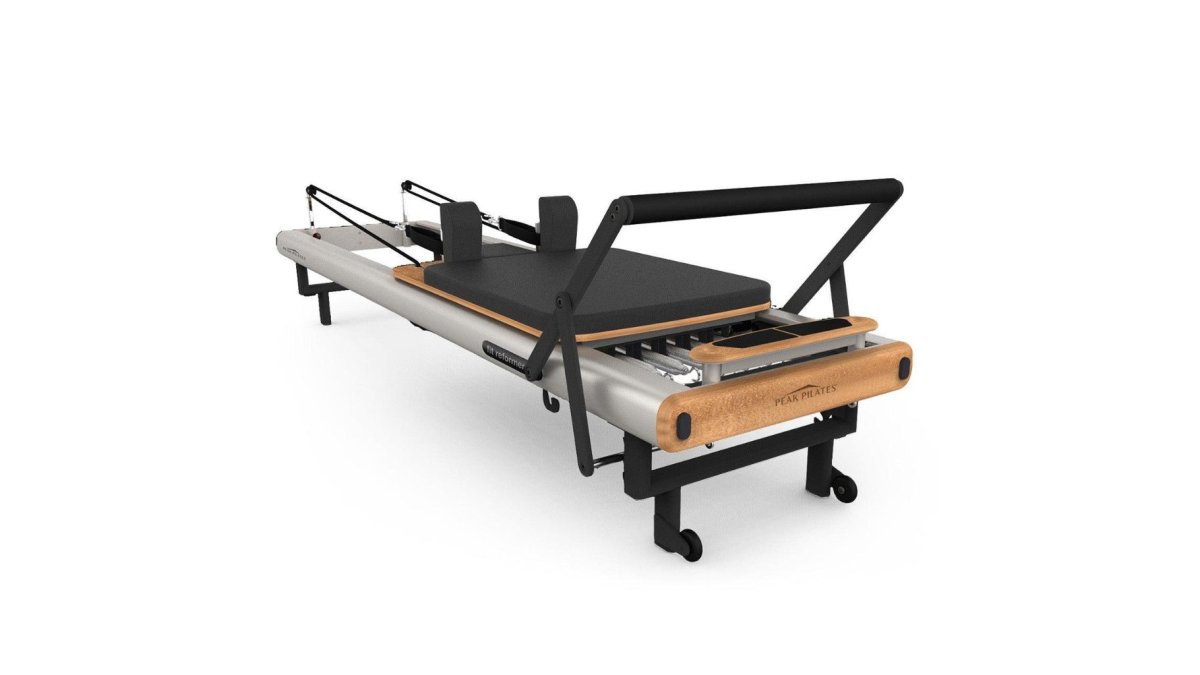
What sets the fit™ apart is its vertical stacking design: stack up to four reformers high without disassembly, ideal for boutique studios with limited square footage.
The fit™ includes a four-position foot bar, three-position headrest, and alignment graphics. The one-hand gear bar simplifies resistance adjustments between exercises, keeping class flow smooth.
Peak Pilates MVe® Reformer and Tower: All-in-One Studio Versatility
The MVe® system combines three machines in one, reformer, tower, and mat, without the footprint of separate units.
The MVe® uses the same five-spring system as the fit™, but adds push-through and roll-down bars, safety chains, and foot loops for tower exercises.
Where the MVe® differs is its integrated approach: clients transition seamlessly from reformer to tower work without changing machines, which suits 50- or 60-minute blended classes.
Peak PilateSystem® Deluxe: Complete Reformer, Cadillac, and Mat System
The Peak PilateSystem® Deluxe is the premium option: a true 3-in-1 system combining reformer, Cadillac, and mat in one machine.

The Deluxe includes a folding carriage and rolling base for storage and repositioning.
At $7,495, the Deluxe is a significant investment. It suits studios prioritizing space efficiency over running multiple clients simultaneously, if your model emphasizes semi-private or private sessions, its versatility justifies the cost.
Peak Pilates Casa™ Reformer: Compact Home and Boutique Option
The casa™ Reformer is designed for home use and small boutique studios that prioritize compact design without sacrificing studio-grade performance.

The casa™ includes a five-spring system, four-position locking foot bar, and three-position headrest. Its lightweight aluminum frame and wide-section wheels ensure stability and smooth operation.
Every casa™ purchase includes two months of free access to the Pilates Project app, giving clients structured programs and expert-led classes.
Home gym builders and solo practitioners who want professional-grade performance without studio-height design or stackability. Not suitable for commercial studios due to durability limitations.
Building Your Pilates Studio Equipment List
A complete studio needs more than reformers, and the order in which you buy matters as much as what you buy. Most new owners overspend on apparatus and underspend on the accessories and layout that determine how many clients they can serve per hour.
Step 1: Plan Your Floor Before You Buy
Start with usable square footage, not a shopping list. Most studio operators budget roughly 40-60 square feet of clear floor area per reformer station, including mat space for mounting, dismounting, and transitions.
Peak Pilates The fit™ Reformer →
A few planning constants worth confirming against your own layout:
- Aisle clearance: Leave at least 36 inches between reformers so clients and instructors can move safely. Tighter spacing works for storage but not for active classes.
- Instructor sightlines: In a group class, the instructor needs an unobstructed line to every carriage. Staggered or angled rows usually beat perfectly parallel rows in narrow rooms.
- Doorway and hallway width: Measure the narrowest point on the delivery path, not just the studio door. A reformer that clears the entrance can still jam in a stairwell or elevator.
A 600-square-foot training floor typically supports 4-6 reformer stations with comfortable aisles. A 1,200-square-foot floor can often double that, but only if storage, props, and client flow are planned from the start.
Step 2: Sequence Purchases by Revenue Impact
Not every piece of equipment earns its keep at the same rate. A practical build order:
- Reformers first. They anchor group classes, semi-privates, and most private sessions. Buy the number that fills your first class schedule, not the number that fills your maximum floor plan.
- Props second. Rings, bands, rollers, overballs, and small boxes let you run mat classes and expand your exercise library for a fraction of the cost of another machine. They also let you serve more clients per class without buying more reformers.
- Tower or Cadillac functionality third. Add this when your client base includes advanced practitioners or rehab clients who need exercises a reformer alone cannot deliver.
- Specialty apparatus last. Chairs, barrels, and spine correctors are valuable, but they serve narrower class formats. Add them once your core schedule is full and you can justify the floor space.
This sequence keeps capital in equipment that generates revenue from day one, rather than apparatus that sits idle until your programming catches up.
Step 3: Match Equipment to Your Business Model
The right mix depends heavily on how you sell sessions:
- Group reformer classes: Prioritize stackable, durable reformers with fast spring changes and consistent carriage feel across units. Uniformity matters more than variety here, clients should get the same experience on every machine.
- Semi-private and private sessions: A mixed fleet works well. Pair standard reformers with one or two all-in-one systems so you can offer tower or Cadillac work without dedicating a separate room.
- Boutique studios with limited space: Favor vertical stacking and multi-function machines. One integrated system can replace two or three single-purpose units, which matters when rent is your largest fixed cost.
Step 4: Budget Beyond the Purchase Price
The sticker price is only part of total cost of ownership. Budget for:
- Delivery and assembly: Studio-height reformers are heavy. White-glove delivery that includes assembly and positioning is often worth the premium, especially for stacked units.
- Maintenance and replacement parts: Springs, wheels, ropes, and foot bar pads wear out with heavy use. Plan for a modest annual maintenance line item rather than treating repairs as surprises.
- Financing: Many commercial equipment purchases can be financed or leased. If cash flow is tight during build-out, financing can preserve working capital for marketing and staffing.
Step 5: Plan for Growth
Your first equipment purchase should not be your last. Leave room in your floor plan and budget for expansion, an additional reformer, a second tower, or a dedicated rehab corner.
If you are unsure how many reformers your space can realistically hold, or which configuration fits your class format, our team can help you map it out before you commit to a purchase. studio equipment planning resources
Pilates Equipment for Rehabilitation and Therapeutic Use
Rehabilitation studios have different equipment priorities than performance-focused boutiques. Clients recovering from injury need precise resistance control, stable mounting surfaces, and instructor-friendly adjustments that let one practitioner safely supervise a session.
What Makes Equipment Rehab-Friendly
Not every studio reformer suits therapeutic work. The features that matter most clinically:
- Fine-grained spring resistance: Five-spring systems with distinct heavy, medium, and light options let you dial resistance down for post-surgical clients and up for athletes in late-stage rehab. The ability to change resistance with one hand also keeps sessions moving.
- Stable, low-friction carriage: A smooth carriage glide reduces the risk of compensatory movement patterns. Uneven or sticky carriages force clients to recruit the wrong muscles to compensate.
- Adjustable foot bar and headrest: Multiple foot bar positions and a three-position headrest accommodate clients who cannot tolerate certain joint angles. This is especially important for shoulder, hip, and knee protocols.
Matching Equipment to Common Clinical Scenarios
Different client populations call for different configurations:
- Post-surgical and early-stage rehab: Prioritize reformers with light spring options and stable mounting. A standard reformer with a five-spring system covers most early-stage protocols.
- Upper-body and postural rehab: Tower or Cadillac functionality is essential. Push-through bars, roll-down bars, and foot loops enable the controlled upper-body and scapular work that pure reformer classes cannot deliver.
- Athletic and late-stage rehab: Higher resistance ranges and the ability to progress load matter more than fine control. A reformer with a full spring range and a stable carriage handles this well.
Space and Workflow for Rehab Studios
Rehab sessions involve more hands-on cueing and setup time than group classes. Plan for:
- Wider aisles: Allow at least 36 inches, and more if you regularly use a gait belt or assist with transfers. Instructors need room to stand on both sides of the carriage.
- Clear transfer zones: Keep the area around each reformer free of props and storage so clients can mount and dismount safely.
- Storage within reach: Springs, blocks, and small props should be stored close to the equipment so instructors are not leaving clients unattended to fetch items.
Working With Referring Providers
If your studio accepts referrals from physical therapists, chiropractors, or physicians, align your equipment with their protocols before you buy. Ask which movements and resistance ranges their patients need, then confirm your equipment supports them.
Props like foam rollers, small boxes, and resistance bands support therapeutic protocols without additional machine investment, and they're inexpensive to replace as they wear out.
If you are building a rehab-focused studio or adding therapeutic services to an existing practice, our team can help you match equipment to your client population and floor plan. rehabilitation studio equipment guidance
Frequently Asked Questions
What equipment does a Pilates studio need to get started?
A functional Pilates studio begins with reformers as the core equipment, they're versatile enough for group classes and individual sessions. Most studios add a tower or Cadillac system for advanced exercises, mats for floor work, and basic props like resistance rings and foam rollers. The specific mix depends on your class format, available space, and budget. Reformers like the Peak Pilates The fit™ are designed for commercial use and stack vertically to save floor space, making them ideal for boutique studios starting out.
How do I choose a Pilates reformer for my studio?
Start with durability and weight capacity, commercial reformers must handle continuous daily use and support clients up to 300 pounds. Consider stacking capability if space is limited; the Peak Pilates The fit™ and MVe® both stack up to four high. Studio height (around 15.5 inches) is important for client comfort and instructor safety. Check the spring resistance system, footbar adjustability, and whether the frame is aluminum or wood. Finally, verify warranty coverage and whether the manufacturer supports commercial environments, not just home use.
What Pilates props are useful for group classes?
Essential props for group classes include resistance rings for upper-body and core work, foam rollers and overalls for mobility and activation, hand weights for added resistance, and resistance bands for varied movement patterns. Tennis balls and Franklin balls support trigger-point release and body awareness. Magic circles (resistance rings) are particularly popular because they're affordable, durable, and work for all fitness levels. Props like small boxes and poles add variety to reformer work and mat classes. They're low-cost additions that expand your exercise library without requiring floor space.
Can Pilates equipment be used for rehabilitation and therapeutic purposes?
Yes. Pilates equipment is widely used in rehabilitation settings because it provides controlled, low-impact movement with adjustable resistance. Reformers allow precise spring tension adjustment, making them suitable for clients recovering from injury or managing chronic conditions. The MVe® Reformer and Tower and Peak PilateSystem® Deluxe both include tower functionality with push-through bars and foot loops, which support therapeutic exercises for mobility and stability. Many physical therapists and clinical Pilates instructors use these systems. Always consult with a healthcare provider to ensure equipment choices align with individual therapeutic goals.
How many reformers should a Pilates studio have?
The number depends on your class size and business model. A boutique studio with 8-12 clients per class typically needs 8-12 reformers. A larger group class or multiple simultaneous sessions requires more. Stacking capability matters: reformers like the Peak Pilates The fit™ that stack vertically allow you to store 3-4 units in the footprint of one, freeing up studio floor space for other equipment or movement areas. Start with enough for your peak class size, then add as your business grows. Vertical stacking design helps studios maximize their investment without expanding their physical footprint.
When you're ready to invest in studio equipment, Revive and Lift can help you plan your space and source the right tools for your teaching style. We carry Peak Pilates reformers, towers, and systems, and we offer white glove delivery and assembly services nationwide. Our team can also help you explore financing options and request quotes for multi-unit studio packages. Shop our Pilates equipment collection and connect with us to discuss your studio's specific needs.


