

Last Updated: November 2, 2026
Quick Summary
Ergonomic strength equipment is commercial gym equipment designed so each user's joints, posture, and range of motion line up with the machine's path of travel. Evaluate every unit on four dimensions: user fit, adjustability, movement path, and access, then test it against a panel of real users before you buy.
- Build a fit panel spanning a broad range of adult heights, including a shorter-reach and a heavier user.
- Score each unit pass or fail on the five-point fit protocol and compare pass fractions across brands.
- A station taking more than about 15 seconds to reset between users will get left in the wrong position.
- Check reach, clear floor space, transfer surfaces, and operable parts as a filter on every unit.
- Run a post-installation trial and track which adjustments users change and which stations get avoided.
Table of Contents
- What Ergonomic Strength Equipment Actually Means for a Facility
- How to Assess Strength Machine Adjustability Before You Buy
- Matching Ergonomics to Equipment Categories and Training Zones
- User Fit Across Diverse Populations and Accessible Fitness Equipment
- Commercial Gym Equipment Safety Standards and Construction Quality
- Commercial Gym Layout and Equipment Spacing for Safe Movement
- Post-Installation Testing: Turning Ergonomics Into Measurable Feedback
- Planning Your Strength Equipment Purchase With Revive and Lift
- Frequently Asked Questions
What Ergonomic Strength Equipment Actually Means for a Facility
Ergonomic strength equipment is commercial gym equipment designed so each user's joints, posture, and range of motion line up with the machine's path of travel.
The concept rests on four dimensions to consider when evaluating any unit:
- User fit: seat height, backrest angle, and reach distance
- Adjustability: how fast and how widely a machine adapts between users
- Movement path: whether the resistance follows natural joint motion
Get those four right and a strength station earns its floor space. Readers weighing rope-based options can also review whether rope training machines fit their facility's needs. Get them wrong and members quietly avoid it.
The Four Ergonomic Dimensions to Evaluate
Each dimension answers a different question. User fit asks whether the machine matches the bodies in your facility. Adjustability asks how many of those bodies it can serve. Movement path asks whether the exercise loads muscles without forcing joints into awkward positions.
A machine that scores well on one dimension but poorly on another creates a bottleneck. A wide weight range means little if the seat only fits tall users.
How to Assess Strength Machine Adjustability Before You Buy
Strength machine adjustability is the range of seat, backrest, handle, and pad positions a unit offers, plus how quickly a user can change them. Most buying guides stop at "check that it adjusts." The useful question is whether the adjustment range covers the bodies in your facility and whether a member can reset the station in seconds between sets. That calls for a repeatable method, not a spec-sheet scan.
Build a Fit Panel Before You Shop
Anthropometric fit means matching equipment dimensions to real body measurements across a population, not to one average user. Before you evaluate any machine, assemble a small panel that reflects your actual membership, spanning a broad range of adult heights.
Record each panel member's height, seated reach, and any joint limitations. You now have a fixed test group you can run against every unit on your shortlist, which turns a subjective "feels fine" into a comparison you can defend.
A Repeatable Five-Point Fit Protocol
Run this on the floor with each panel member, in the same order, and score each point pass or fail. The goal is to find where the setup breaks down, not to confirm it works.
- Seat height and foot contact: With feet flat, the knees should sit near a right angle and the thighs should rest on the pad without a gap under the hamstrings. Fail if a shorter user's feet dangle or a taller user's knees rise above hip level at the lowest seat setting.
- Backrest and lumbar support: The pad should fill the lower back curve without pushing the shoulders forward or leaving the head unsupported. Fail if the user has to round the spine to reach the handles.
- Grip and elbow position: Handles should be reachable with a slight elbow bend at the start position, never locked straight. Fail if the user must shrug or lean out of the pad to grip.
- Starting reach: The first inch of the movement should not pull the shoulder past a comfortable stretch. Fail if the user's torso lifts off the backrest to begin the rep.
- End range of motion: The finish position should stop before the joint feels pinched or hyperextended. Fail if the user has to shorten the rep to avoid discomfort.
Score each unit as a fraction of panel members who pass all five points. A machine that passes four of six users is a different purchase than one that passes six of six, and that number is what you compare across brands.
Measure Adjustment Time and Increments
Range matters, but so does speed. Time how long it takes a panel member to move from one setting to another and back.
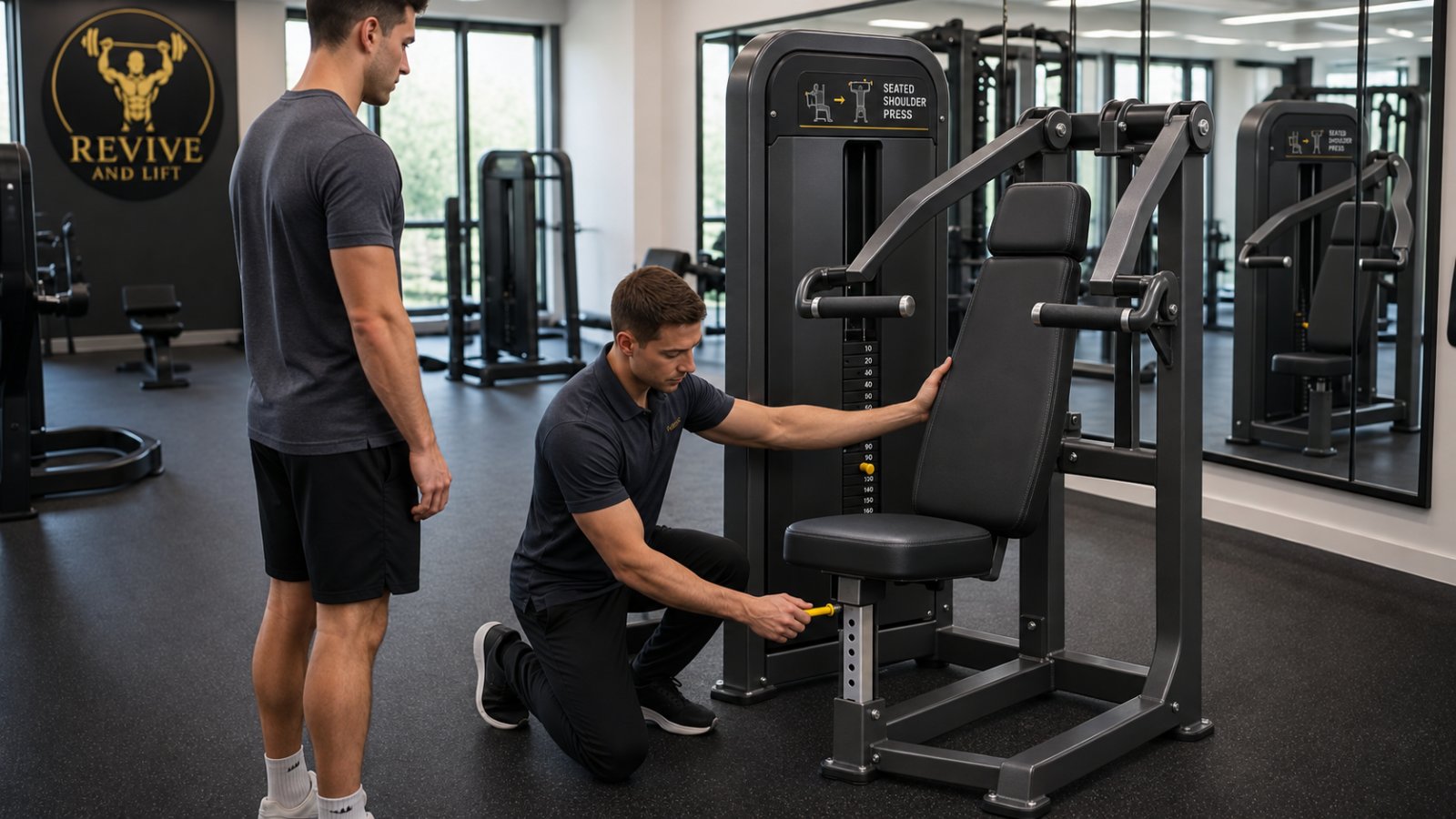
Gym staff adjusting the seat of a selectorized shoulder press machine for a client in a commercial facility
Test the Units You Are Actually Considering
A highly adjustable unit such as a commercial functional trainer can be a useful stress test for this protocol, since its pulleys and handles move through many positions and can expose reach problems quickly.
The single most common mistake is testing adjustability with only one staff member. Bring in a shorter and a taller colleague, or a member of each, and watch where the setup breaks down.
The five-point fit protocol gives every panel member the same test, scored pass or fail on each point.
Checkpoint |
What to look for |
Fail if |
|---|---|---|
Seat height and foot contact |
Feet flat, knees near a right angle, thighs on pad |
Feet dangle or knees rise above hip level |
Backrest and lumbar support |
Pad fills lower back curve, head supported |
User rounds spine to reach handles |
Grip and elbow position |
Handles reachable with slight elbow bend |
User shrugs or leans out of pad to grip |
Starting reach |
First inch does not pull shoulder past comfortable stretch |
Torso lifts off backrest to begin rep |
End range of motion |
Finish stops before joint feels pinched |
User shortens rep to avoid discomfort |
Matching Ergonomics to Equipment Categories and Training Zones
Ergonomics by equipment category matters because a squat rack, a cable station, and a selectorized shoulder press each load the body differently. Free weights demand more stabilization, so clear space and spotting access matter most.
Our selectorized lineup shows how category-specific ergonomics works in practice. The FLEXORA Commercial Shoulder Press uses a biomechanically designed motion path with an adjustable seat and back pad to fit different users. The FLEXORA Commercial Multi Row supports seated, wide-grip, close-grip, and single-arm rows from one station, so users change grip rather than machines.


Boutique operators often want a tighter, curated list. Our guide to strength equipment picks for boutique gyms narrows the field by space and training style.
User Fit Across Diverse Populations and Accessible Fitness Equipment
Accessible fitness equipment is strength equipment that many body sizes, ages, and abilities can set up and use without help. Anthropometric fit, meaning how equipment dimensions match real body measurements across a population, is the measure that matters here. Most facilities serve members from well under five feet to over six and a half feet tall, and a growing share of members have limited mobility, a prosthetic, or a condition that changes their reach and grip.
Use Reach and Transfer Dimensions, Not Guesswork
Rather than eyeballing accessibility, check the dimensions that determine whether a member can actually use a station. Accessibility guidance for recreation facilities can serve as a starting point, and the official source should be consulted for current figures:
FLEXORA Commercial Shoulder Press | Anatomy Fitness →
- Reach: Controls and handles should sit within a comfortable reach for seated and standing users.
- Clear floor space: Allow clear floor area beside a station for a wheelchair or walker to approach and for a member to transfer.
- Operable parts: Controls should need no tight grasping, pinching, or twisting of the wrist (Chapter 3: Operable Parts).
Apply these as a filter to every unit on your list. A selectorized machine whose weight pin sits below knee height or whose seat is fixed too high fails a member before the first rep.
Check Adjustment Ranges Against Your Membership
Seat pads should adjust in small enough increments to matter, and the lowest and highest settings should cover the shortest and tallest users you actually serve. Handles should be reachable without shoulder overreaching at the start position. Open frames that allow a wheelchair or walker to approach, clear floor space beside the station for transfer, and labels and adjustment points a first-time user can find all belong on the same checklist.
Evaluate Usability, Not Just Access
Getting onto a machine is only half the test. Watch whether a member with limited grip can change the weight, whether the pad contours support a user with a larger frame, and whether the movement path forces a joint into a range the user cannot reach. A station that is technically accessible but awkward to set up will still get avoided.
Commercial Gym Equipment Safety Standards and Construction Quality
Commercial gym equipment safety standards cover frame stability, load ratings, and testing before a unit reaches your floor.
Construction quality shows up in the details. Look for heavy-duty steel frames, quality cables, and hardware rated for repeated high-traffic use.
Watch out: buying on price alone often means thinner frames and lower-rated cables. Those units fail faster in high-traffic settings and cost more to replace.
Where a standard or certification claim appears in a supplier's materials, ask for the source. ASTM International standards for fitness equipment publishes the test methods many manufacturers reference, and it is worth confirming which apply to the units you are considering.
Commercial Gym Layout and Equipment Spacing for Safe Movement
Commercial gym layout and equipment spacing decide whether members move safely between stations or crowd into each other. Plan clear pathways first, then place equipment around them.
Start with these layout rules:
- Keep walkways wide enough for two people to pass
- Leave loading and spotting space in front of racks and benches
- Group machines by training zone so members do not cross the floor mid-workout
Spacing also protects ergonomics. A machine set too close to a wall limits range of motion and forces awkward setup. Walk the finished layout with a tape measure before you order.
Post-Installation Testing: Turning Ergonomics Into Measurable Feedback
Post-installation testing is how you confirm a machine fits real users after it is installed. Run a short trial with staff and a handful of members of different sizes, then record what you find.
Track three things:
- Which adjustments users actually change
- Where setup breaks down for shorter or taller users
- Which stations get avoided or used incorrectly
That feedback turns ergonomics from a guess into a checklist you can act on. If a station needs a pad swap or a reposition, fix it before opening day traffic arrives.
Planning Your Strength Equipment Purchase With Revive and Lift
Choosing ergonomic commercial strength equipment comes down to fit, adjustability, movement path, and access, tested against real users before and after install.
That is where we can help. Revive and Lift carries strength equipment from brands including Anatomy Fitness, TKO Strength & Performance, and York Barbell, with full manufacturer warranties.
Get started with Revive and Lift and build a strength floor that fits the people using it.
Frequently Asked Questions
What ergonomic features should commercial strength equipment have?
Look for adjustable seats and back pads, clearly marked adjustment points, multi-grip handles, and a resistance path that follows natural joint movement. A selectorized machine like the FLEXORA Commercial Shoulder Press pairs an adjustable seat and back pad with a biomechanically designed motion path and a 1:2 resistance ratio, which lets users of different sizes and strength levels share one station. Fixed, single-position machines force users to adapt to the equipment instead of the equipment adapting to them.
How do you choose strength equipment for users of different heights and abilities?
Start with adjustability range, not the average user. Measure the shortest and tallest people who will actually train in your space, then confirm seat height, back pad depth, and handle reach cover both ends of that spread. Add at least one accessible fitness equipment option with open access and clear transfer space. Machines with adjustable thigh pads, ankle rollers, and multi-grip handles, such as the FLEXORA Lat Pulldown and Lying Leg Curl, accommodate more body types without extra stations.
How much space should be left around commercial strength equipment?
Commercial gym layout and equipment spacing should follow the movement each machine requires, not a single blanket number. Leave enough room behind a lat pulldown or multi row for a full arm extension, and enough clearance at a lying leg curl for a user to mount and dismount safely. Keep clear pathways between zones so members never squeeze past someone mid-set. Map traffic flow on paper before delivery, and confirm ceiling clearance and floor loading for every station.
How should gym owners evaluate the fit of strength machines?
Run a structured fit test before committing to a full rollout. Sit on the machine, adjust every point, and check that joint alignment and neutral posture hold through the full range of motion. Watch for overreaching, awkward grip position, or a seat that bottoms out. Then have staff and a few members of different sizes repeat the test and record feedback. Order one unit first, test it for a few weeks in real traffic, and only then expand the order.


