

Last Updated: October 26, 2026
Quick Summary
The best rope training machines for gyms are commercial-grade units sized to your peak class, with rack-mount models adding a station with no floor space and dual or tri-station models letting two or three members train at once. Match station count to your largest rope class, then confirm ceiling height, flooring, and warranty coverage before ordering.
- A rack-mount rope trainer attaches to a rig you already own and adds a station with no additional floor space.
- A common boutique pattern is a 12-person class with three rope stations running 40-second intervals.
- Plan for the machine footprint plus a clear pull zone of several feet in front of the drum.
- Choose a model with an adjustable pulley so members can pull from standing, seated, or kneeling positions.
- Ask for a written parts list and current replacement-part availability before you buy.
Table of Contents
- What a Rope Training Machine Actually Does for Your Gym
- Rope Machine Workout Benefits That Matter to Members
- Quick Comparison: Rope Training Machines for Gyms
- How to Choose Gym Rope Equipment for Your Space
- Best Rope Trainer Exercises for Group Classes and Solo Sessions
- Why a Commercial Rope Trainer Beats Consumer-Grade Alternatives
- Budgeting for a Rope Training Machine: What Drives the Price
- Plan Your Rope Training Station with Revive and Lift
- Frequently Asked Questions
What a Rope Training Machine Actually Does for Your Gym
A rope training machine is a self-powered resistance station that uses a continuous loop of rope to deliver strength and cardio work in one unit.
The mechanism matters more than the marketing. Pulling the rope spins a drum, and resistance changes with how hard and how fast you pull, so a beginner and a competitive athlete can share the same station with no pin changes or resets between users.
What separates a commercial rope trainer from a consumer unit is duty cycle.
Rope Machine Workout Benefits That Matter to Members
Members keep coming back to rope machines because the work feels different from a treadmill or a cable stack.
The conditioning effect is the real draw.
Rope work is also easier on the joints than running. With no impact loading through the knees and ankles, the machine suits older members, rehab clients, and anyone returning from injury, widening the membership base it can serve.
Quick Comparison: Rope Training Machines for Gyms
The right rope training machines for gyms come down to how many users you need to serve at once and how much floor you can give up. Here is how the main formats compare.
Format |
Users at Once |
Floor Space |
Best For |
Example Model |
|---|---|---|---|---|
Rack-mount |
1 |
None (attaches to rack) |
Tight studios, rigs |
|
Single upright |
1 |
Small |
Small studios, solo training |
|
Dual station |
2 |
Moderate |
Small group classes |
|
Tri-station |
3 |
Moderate |
Class programming, teams |
Ropeflex RX2500T Tri-Station |
Single-User vs. Multi-Station Models
Single-user units make sense when rope work is an accessory, not the main event. A rack-mount model attaches to equipment you already own and adds a station without costing a square foot of floor, while a standalone single unit gives one member a dedicated spot.


Multi-station models change the math for class-based studios. A dual or tri-station lets two or three members train simultaneously, which is what makes rope intervals work in a scheduled class.
Indoor vs. Outdoor Rope Trainers
Indoor units are built for climate-controlled floors and are not intended for outdoor placement. If you run boot camps, outdoor conditioning, or a training space without walls, an all-weather model with a sealed mechanism and weather-resistant coating is the correct choice.
How to Choose Gym Rope Equipment for Your Space
Start with the room and the class schedule, not the catalog. The right rope training machine for a boutique studio fits your floor plan, matches your peak class size, and survives your weekly schedule. Most buying mistakes come from sizing the machine to the room instead of the class.
Capacity Planning: How Many Stations Do You Actually Need?
Work backward from peak usage. Count the largest class that includes rope work, then divide by the members who can rotate through a station in one interval. A common boutique pattern is a 12-person class with three rope stations running 40-second intervals, giving every member three to four rope turns per class.
A simple planning formula:
- Stations needed = peak class size ÷ rotations per member per class
- Rotations per member = total rope block minutes ÷ (work interval + transition time)
- Throughput per station = 60 ÷ (work interval + transition time) members per hour
For example, a 45-minute class with a 15-minute rope block, 40-second work intervals, and 20-second transitions gives each station about 15 rotations per hour.
Space-Efficient Layouts and Traffic Flow
Rope trainers are vertical machines, so the footprint is smaller than the reach. Plan for the machine footprint plus a clear pull zone of several feet in front of the drum.
Lay out stations so members do not cross through each other's pull zones.
Storage matters too. Ropes, handles, and accessories need a home between classes so the floor stays clear; wall hooks, bins, or a small cart near the station cut transition time and reduce trip hazards.
Footprint, Flooring, and Ceiling Height
Vertical rope trainers are tall units, so ceiling height and clearance above the machine matter. For fitting equipment into constrained rooms, our guide to space saving functional trainers walks through layout options.
Flooring deserves the same attention. Rope work involves pulling and bracing, so a stable, non-slip surface under the machine protects members and equipment; rubber mats and athletic flooring absorb vibration and protect the subfloor.
Commercial Durability and Warranty Coverage
Durability is where cheap units reveal themselves. Look at the frame gauge, drum mechanism, and warranty terms for each component, because a strong frame warranty paired with a short bearing warranty tells you where the manufacturer expects wear. For a boutique studio running 20 to 30 classes a week, the drum and bearings see the most cycles.
Ropeflex RX4400 APEX Endless Climber →
For a broader look at what separates long-lasting equipment from short-lived units, read our commercial grade fitness equipment durability guide.
Accessibility and Inclusive Setup
A rope trainer can serve a wider range of members than almost any other strength station because resistance adjusts to the user. Choose a model with an adjustable pulley so members can pull from standing, seated, or kneeling positions, and keep a stable bench or box nearby for seated pulls. Leave clear floor for a wheelchair or walker to approach, and post setup cards showing pull angles so new members can start without a coach.
Best Rope Trainer Exercises for Group Classes and Solo Sessions
Rope machines support more exercises than most members expect. The adjustable pulley on many models lets you change the pull angle, so one station trains the whole body.
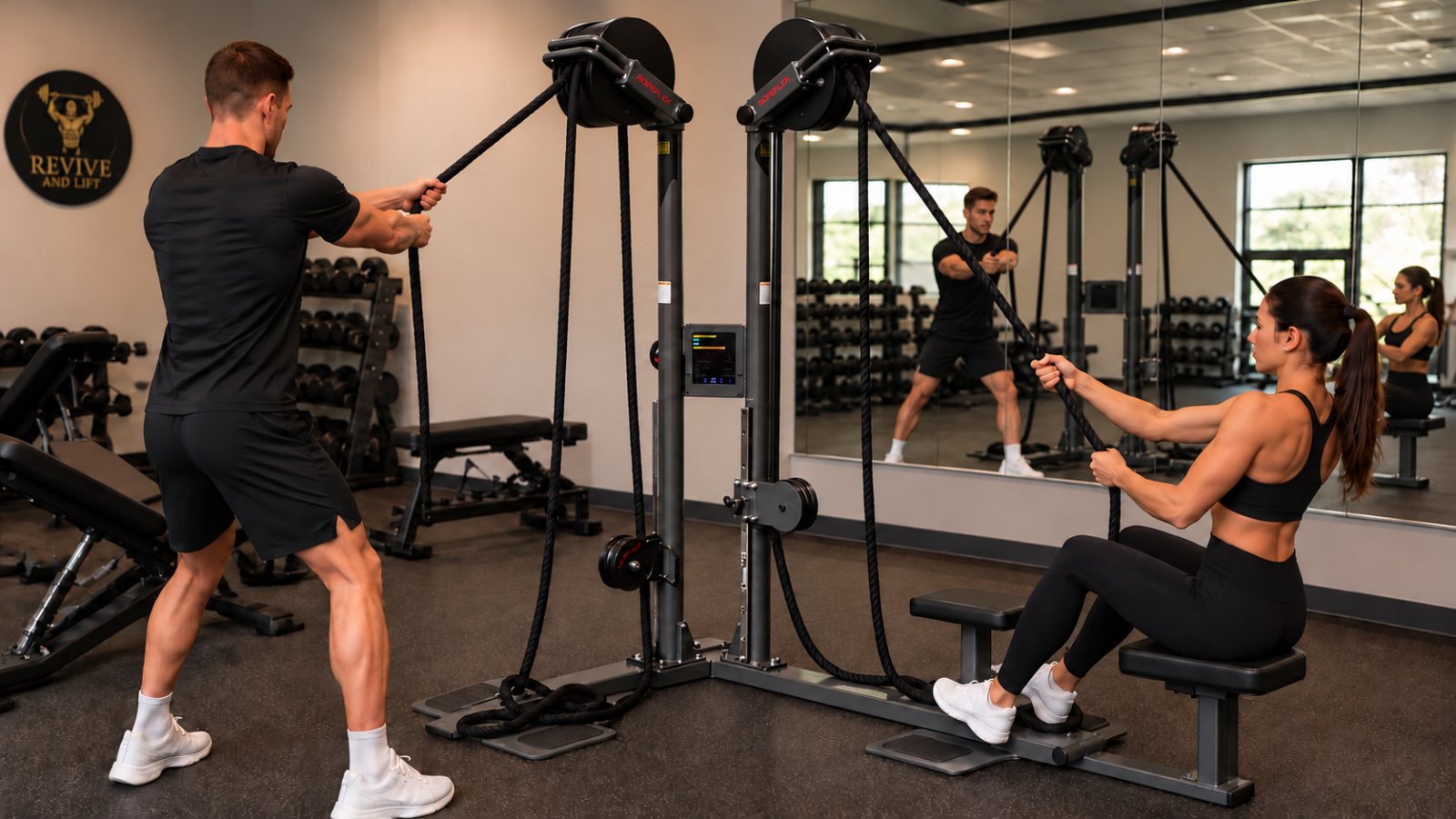
Two athletes performing rope training exercises in a modern boutique gym with mirrored walls
Here are the rope trainer exercises we see programmed most often:
- Standing rope pull: continuous pulls at chest height for conditioning intervals
- High-angle pull-down: targets lats and grip with the pulley raised
- Low-angle drag: works the posterior chain and core with the pulley lowered
For group classes, alternate work and rest intervals so members rotate through stations. For solo sessions, members can pair rope intervals with free weights, kettlebells, or bodyweight exercises to build a complete circuit.
Why a Commercial Rope Trainer Beats Consumer-Grade Alternatives
Consumer units are built for occasional use by one person; commercial rope trainers are built for a schedule.
A commercial unit also comes with the support structure a business needs. Manufacturer warranties, service documentation, and parts availability matter when a machine goes down and a class is scheduled in an hour.
There is a safety angle too. A commercial rope trainer gives members a controlled, continuous rope with no ceiling anchor and no loose end, removing the fall risk of traditional rope climbing while keeping the training effect.
Budgeting for a Rope Training Machine: What Drives the Price
Price on a rope training machine tracks three things: the number of stations, the resistance system, and the frame construction. A single rack-mount unit costs far less than a tri-station group trainer because it carries one drum instead of three. Rather than quote a single number, plan around total cost of ownership over the machine's service life.
What Drives the Sticker Price
- Station count: Each additional drum and rope path adds cost. A dual or tri-station is a bigger upfront commitment but spreads the per-member cost across more users per class.
- Resistance system: Magnetic progressive resistance systems cost more than simple friction drums but require less maintenance and adjust automatically. Friction units are simpler and cheaper to service, which suits budget-conscious studios.
- Frame and finish: Heavy-gauge steel, powder coating, and sealed bearings add cost upfront and reduce service calls later.
Total Cost of Ownership: What to Budget Beyond the Machine
A rope trainer is a capital purchase plus an operating cost. Budget in four buckets:
- Equipment and delivery: The machine itself plus freight. Oversized freight to a commercial address is a line item worth confirming before you order.
- Installation and assembly: Rack-mount units need mounting hardware and labor; standalone and multi-station units need assembly and leveling. White glove delivery and assembly removes this burden from your team.
- Flooring and site prep: Mats, platform work, and any electrical or anchoring changes.
- Consumables and service: Ropes, handles, and bearings wear on a schedule. Budget an annual service allowance and a rope replacement reserve based on class volume.
A useful planning rule is to set aside an annual maintenance reserve equal to a small percentage of the equipment cost, then track actual service calls against it. High-volume studios replace ropes more often than low-volume facilities, so match the reserve to your schedule rather than the machine's list price.
Financing and Cash-Flow Options
Financing spreads the upfront cost across the machine's service life, which matters for a new studio or a location adding a second rope zone. Compare the total financed cost against paying outright, and confirm whether the lender requires a personal guarantee. For multi-station purchases, ask about project quotes that bundle delivery, installation, and accessories into one invoice.
Replacement Cycles and Resale
Commercial rope trainers are built to last, but ropes, handles, and bearings are wear items. Plan rope replacement on a schedule tied to class volume, and keep a spare on hand so a worn rope does not cancel a class. Frames and drums typically outlast wear parts by years, which is why a commercial unit with a strong frame warranty is cheaper over a decade than replacing consumer units.
Plan Your Rope Training Station with Revive and Lift
Choosing rope training machines for gyms is a planning problem before it is a purchasing problem. Get the station count, footprint, and durability requirements right, and the equipment decision becomes straightforward.
Revive and Lift carries Ropeflex rope trainers across single, dual, and tri-station formats, plus rack-mount and outdoor options.
Get started with Revive and Lift and build a rope training station that fits your space, your classes, and your members.
Frequently Asked Questions
What is a rope training machine and how does it work?
A rope training machine is a self-powered unit that uses a continuous loop of rope running through a resistance drum. You pull hand over hand, and the resistance adjusts automatically based on how fast and hard you pull. Ropeflex models use DSS Progressive Resistance, which shifts from roughly 10 to 200 pounds without knobs or levers. That makes rope training machines suitable for beginners and elite athletes in the same class, with no ceiling-mounted ropes and no motor required.
What muscles do rope training machines work?
Rope training machines engage the arms, shoulders, back, core, and legs through continuous pulling. Vertical pulls target the lats and grip, horizontal pulls hit the rear delts and mid-back, and lower pulley positions let you add squats and rotational work. Because every pull demands stabilization, the core stays active throughout. The result is a full-body conditioning stimulus that builds strength endurance rather than raw max strength, which suits group classes and athletic circuits well.
How much space does a rope training machine need?
Footprint varies widely by model. The Ropeflex RX2100 rack-mount unit measures just 16 by 13 inches and attaches to an existing rack or wall, while the RX2500T Tri-Station occupies a 70 by 70 inch area for three users. Single upright trainers like the RX2500 ORYX take roughly 48 by 35 inches. Measure your floor space, confirm ceiling height clears the tallest unit, and leave room for users to step back during pulls.
Are rope training machines suitable for commercial gyms and boutique studios?
Yes. Commercial rope trainers are built with heavy-duty 11-gauge steel frames and carry full commercial warranties, often 10 years on the frame and 3 years on pulleys and bearings. Multi-station models like the RX2500D and RX2500T let two or three members train at once, which improves throughput during peak hours. For boutique studios running small-group classes, a dual or tri-station unit often replaces several single-purpose machines in the same floor area.
How do you maintain a rope training machine in a busy gym?
Ropeflex machines use magnetic or friction resistance with no belts or gears, so routine upkeep is minimal. Wipe the rope and upholstery daily, check the pulley pop-pin and mounting bolts weekly, and inspect the rope for fraying. Ropes and upholstery typically carry a 90-day to 6-month warranty, so plan to replace them periodically in high-traffic facilities. Keep the unit on a level surface and confirm transport wheels lock securely before use.


