

Table of Contents
- Best Space Saving Functional Trainers: Quick Comparison
- Functional Trainer Footprint Requirements: What Actually Fits
- TKO 8060FT2: Compact Dual-Stack Cable System for Tight Rooms
- FLEXORA Functional Trainer: Full Commercial Coverage in 68.7 Inches
- Single Stack vs Dual Stack Functional Trainer: Which Configuration Fits Your Space
- Wall Mounted Functional Trainer Options That Free Up Floor Space
- Installation, Delivery, and Assembly Constraints to Plan For
- Conclusion: Matching the Machine to Your Room
- Frequently Asked Questions
Last Updated: October 5, 2026
Best Space Saving Functional Trainers: Quick Comparison
The best space saving functional trainers are compact cable systems that fit a home gym corner, basement, or garage without sacrificing exercise variety. At Revive and Lift, we help buyers match machines to real rooms. This guide compares four options by footprint, ceiling height, and usable clearance.
Below, we break down what actually fits and where most buyers get the measurements wrong.
Trainer |
Price |
Footprint (W x D x H) |
Best For |
|---|---|---|---|
$4,400 |
59" x 50" x 88" |
Tight rooms, light commercial |
|
FLEXORA |
$7,899 |
68.7" x 42.5" x 94.7" |
Full commercial coverage |
Ropeflex RX2300 IBEX |
$3,099 |
48" x 48" x 61" |
Low ceilings, rope training |
ANCORE Wall Mount |
$29 |
2.25" x 3" (wall) |
Zero floor footprint |
How We Measured Footprint and Usable Clearance
We use manufacturer-published dimensions throughout. Usable clearance means the working space around a trainer, not just its base.

For cable machines, plan for roughly 3 feet of clearance on each cable side and 2 feet behind the frame. High-pulley exercises need the frame height plus about 12 inches of headroom.
Functional Trainer Footprint Requirements: What Actually Fits
A functional trainer needs its base dimensions plus working clearance, and the two are not the same number. Most listings publish only the base footprint, which is why so many home gym plans fail after delivery.
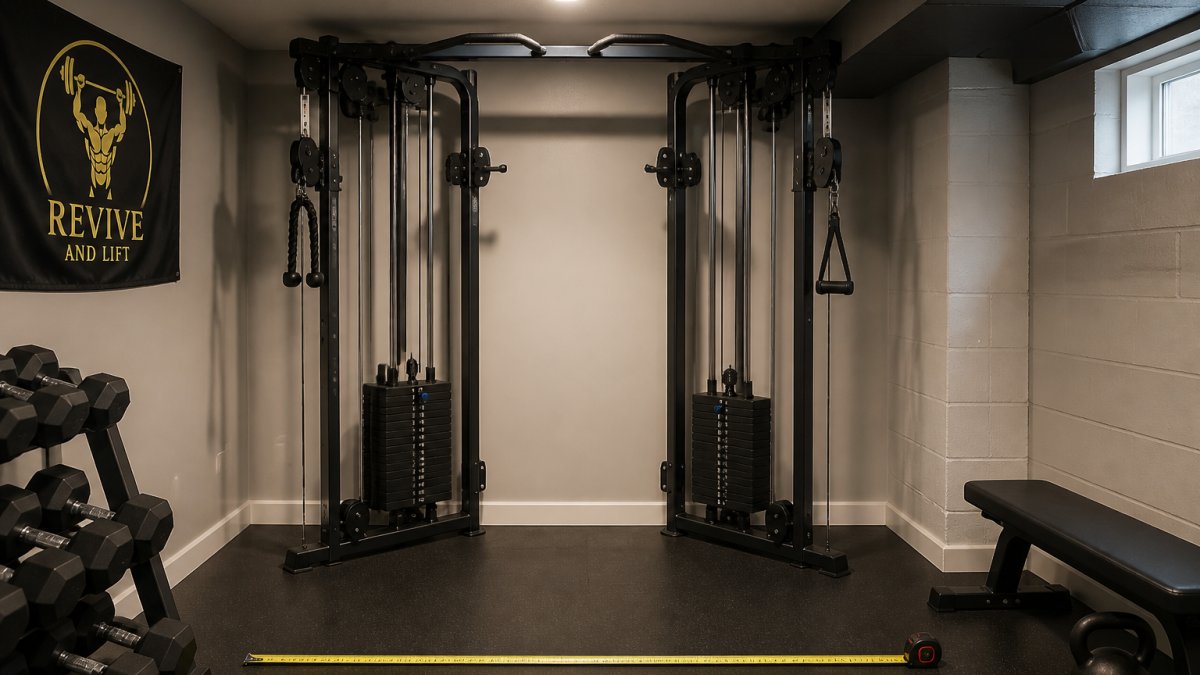
Listed Footprint vs. Working Footprint
We separate every machine into two numbers:
- Listed footprint: the base width and depth as published by the manufacturer.
- Working footprint: the listed footprint plus the clearance needed to move around the machine and perform exercises.
For cable machines, a common planning rule is roughly 3 feet of clearance on each cable side and 2 feet behind the frame, about 6 feet added to total width and 2 feet to depth. A machine listed at 59 inches wide can therefore need close to 9 feet of usable wall.
Standardized Comparison Table
Trainer |
Listed Footprint (W x D x H) |
Working Width (approx.) |
Working Depth (approx.) |
Min. Ceiling for Overhead Work |
|---|---|---|---|---|
TKO 8060FT2 |
59" x 50" x 88" |
~107" |
~74" |
~100" |
FLEXORA |
68.7" x 42.5" x 94.7" |
~117" |
~67" |
~107" |
Ropeflex RX2300 IBEX |
48" x 48" x 61" |
~96" |
~72" |
~73" |
2.25" x 3" (wall) |
Wall-dependent |
Wall-dependent |
Wall-dependent |
Working width and depth are planning estimates based on the clearance rule above, not manufacturer figures.

Room-Fit Checklist: Ceiling Height, Clearance, and Flooring
- Measure wall-to-wall width, then subtract 6 feet for working clearance
- Measure floor-to-ceiling height, then subtract 12 inches for overhead pulley work
- Confirm the frame height fits under any ductwork, beams, or garage door tracks
Space Efficiency: Movements per Square Foot
Compact dimensions alone do not tell you whether a machine is worth its floor space. A more useful measure is how many distinct movements it supports relative to its working footprint.
- A dual-stack cable tower supports crossovers, presses, rows, pulldowns, and unilateral work from one station, which spreads its working footprint across a wide exercise range.
- A rope trainer supports a narrower movement set but needs less working depth, so it can win in rooms where depth is the binding constraint.
- A wall mount removes the floor footprint entirely but depends on wall length and stud placement rather than floor area.
When two machines have similar listed footprints, compare working footprint and exercise list together. The smaller machine is not automatically the better fit if it forces you to add a second station.
TKO 8060FT2: Compact Dual-Stack Cable System for Tight Rooms
The TKO 8060FT2 is a dual-stack functional trainer built for home gyms, personal training studios, and apartment fitness centers where floor space is limited.
Twenty adjustable pulley height positions let users of different sizes set the cable path correctly, and the full metal shroud adds safety and durability.
What we like: the dual-stack design at this footprint is rare, and the expandable resistance means the machine grows with you.
TKO Strength & Performance product specifications
FLEXORA Functional Trainer: Full Commercial Coverage in 68.7 Inches
The FLEXORA from Anatomy Fitness packs commercial-grade capability into a 68.7" L x 42.5" W footprint. Dual 235 lb stacks give 470 lbs of installed resistance, and rotating pulley frames adjust for both height and angle.
- Integrated long bend pull-up bar with foldable footrest
- Included attachments: triceps ropes, nylon handles, short bar, ankle cuffs, lat pulldown bar
- Nylon-coated aircraft cables rated to 2,820 lbs
The tradeoff is height: 94.69 inches means roughly 9-foot ceilings, and its weight makes professional installation the right call.
Anatomy Fitness FLEXORA trainer details
Single Stack vs Dual Stack Functional Trainer: Which Configuration Fits Your Space
A dual-stack functional trainer gives each cable its own weight stack, while a single-stack machine runs both cables from one.
Dual-stack systems cost more and take slightly more width, but allow independent left and right loading, unlocking single-arm rows, offset carries, and rehab work. Single-stack machines are cheaper and simpler to maintain, but both cables share one resistance source, limiting unilateral training.
Factor |
Single Stack |
Dual Stack |
|---|---|---|
Unilateral training |
Limited |
Full support |
Footprint |
Slightly narrower |
Slightly wider |
Price |
Lower |
Higher |
Best for |
Beginners, light use |
Serious training, studios |
Wall Mounted Functional Trainer Options That Free Up Floor Space
Wall mounted options remove the floor footprint entirely, making them the strongest answer for small apartments and shared rooms. The ANCORE Wall Mount installs into a wood stud and holds a fixed training point for your ANCORE unit.
For adjustable height, the ANCORE Sliding Track Mount runs a six-foot steel track along the wall.

A middle path: the ANCORE Rack Mount converts an existing squat rack into a cable station.
Rope Trainers and Rack Mounts as Cable Alternatives
Rope trainers trade cable crossover geometry for a smaller footprint and a different training stimulus. The Ropeflex RX2300 IBEX measures 48" x 48" x 61" and switches between vertical and horizontal rope modes by tilting 90 degrees.
The Ropeflex RX2100 mounts to a rack, rig, or wall with no extra floor space, and its DSS Progressive Resistance adjusts from 10 lbs to 200 lbs based on pulling speed.
Ropeflex rope training systems
Installation, Delivery, and Assembly Constraints to Plan For
Delivery and assembly constraints decide as many home gym purchases as machine specs do. A 926 lb assembled trainer does not arrive ready to use, and a 59-inch frame will not fit through every doorway.
Access Route: Doorways, Stairs, and Turns
Measure the narrowest point on the path from your door to the setup spot, not just the doorway. Crated machines are often wider than the assembled frame, and a tight stair turn can block delivery even when the doorway clears.
- Measure doorway width, stair width, and any hallway turns.
- Check ceiling height in stairwells and landings, since a tall crate can jam on a low turn.
- Confirm whether the crate can be broken down outside and carried in pieces if the full crate will not fit.
Assembly: Time, Tools, and People
Most trainers ship partially assembled and require two people for frame and stack installation. Plan for:
- Two-person minimum for frame and weight-stack assembly on full-size towers.
- Basic hand tools plus the manufacturer's included hardware; some units need a socket set and a level.
- Assembly space of at least the working footprint plus a few feet to lay out parts before final positioning.
Anchoring: Studs, Walls, and Rentals
Wall mounts and rack mounts require stud mounting. Check stud location before committing to a wall position.
- Wall mounts need a wood stud and the manufacturer's included hardware; the ANCORE Sliding Track Mount uses 4" screws and recommends placement 6 to 12 inches from the floor with 4 feet of spacing between two tracks for dual-arm setups.
- Rack mounts fit racks 2 to 4 inches wide with 5/8" to 1" hole diameters, so measure your existing rack before ordering.
- In a rental or finished basement, anchoring into studs may require landlord approval or a wall-repair plan at move-out. Freestanding towers avoid this constraint but take more floor space.
Noise, Flooring, and Shared Rooms
Cable machines generate noise from the pulley and weight stack, which matters in apartments and multipurpose rooms.
- Rubber tiles or mats reduce vibration transfer and protect shared-room floors.
- Nylon-coated cables and shrouded stacks tend to run quieter than exposed stacks.
- If the room doubles as a living space, a wall mount or rope trainer keeps the floor clear between sessions.
Long-Term Ownership: Cables, Pulleys, and Parts
Cable and pulley upkeep is the main long-term cost of ownership. Plan for:
- Periodic inspection of cables for fraying and pulleys for smooth rotation.
- Replacement cables and handles, which are wear items on any cable machine.
- Warranty terms, which vary by manufacturer and often cover the frame longer than the cables.
Revive and Lift offers nationwide white glove delivery and assembly. Commercial buyers can also request project quotes and sourcing help.
Conclusion: Matching the Machine to Your Room
The hardest part of buying a space saving functional trainer is not choosing a brand.
Our recommendation: measure your ceiling and wall first, then pick the configuration that fits. For tight rooms with standard ceilings, the TKO 8060FT2 dual-stack delivers cable training in a 59-inch width.
Revive and Lift carries all of these options as an authorized dealer, with full manufacturer warranties, financing through Affirm and Shop Pay, and white glove delivery and assembly available nationwide.
Frequently Asked Questions
How much space do you need for a functional trainer?
Plan for the machine's footprint plus roughly 2 to 3 feet of clearance on the working sides. The TKO 8060FT2 measures 59 x 50 x 88 inches, while the FLEXORA comes in at 68.7 x 42.5 x 94.7 inches. A room 8 feet wide by 10 feet deep handles most compact trainers with room to move. Measure your ceiling too: 88 to 95 inches of height is typical, so basement gyms need extra checking.
How do I choose between a single stack and dual stack functional trainer?
A dual stack machine gives each cable its own weight stack, so you can train one arm at a time at full resistance or run cable crossovers with balanced load. Single stack designs cost less and take up less width, but limit unilateral work. If your training includes rehab, single-arm rows, or crossover patterns, the dual stack is worth the extra floor space. The TKO and FLEXORA are both dual stack.
What are the benefits of a wall mounted functional trainer?
Wall mounted options remove the footprint problem entirely. The ANCORE Wall Mount is 2.25 x 3 inches and installs into a wood stud, while the 6-foot ANCORE Sliding Track Mount adds adjustable height without a floor frame. You keep full cable training while the floor stays clear for mats, racks, or stretching. The trade-off is installation: both require stud mounting and permanent placement.
Are compact functional trainers stable enough for heavy lifting?
Stability comes from weight and frame construction, not overall size. The FLEXORA weighs 926.38 lbs assembled on a 2.5mm iron steel frame, and the TKO 8060FT2 weighs 825 lbs with a full metal shroud. Both are built for repeated heavy cable work. If you plan to push near the top of the weight stack, anchor the machine or place it against a wall to limit any rocking.
Can a functional trainer replace a full home gym?
For most cable-based training, yes. A dual stack trainer covers chest press, rows, pulldowns, curls, triceps work, core, and lower-body cable exercises. The FLEXORA adds an integrated pull-up bar, and the TKO 8060FT2 includes a multi-grip pull-up bar. You would still want free weights for barbell lifts, but a compact trainer handles the majority of accessory and functional work in one station.


