

Table of Contents
- Why a Commercial Gym Equipment Project Quote Request Saves You Money
- What to Include in Your Gym Equipment Quote Template
- How Commercial Gym Design Services Shape Your Quote
- Step-by-Step Fitness Equipment Procurement Process
- Requesting a Custom Quote: What Suppliers Need From You
- Comparing Quotes: A Framework for Total Cost of Ownership
- Financing, Leasing, and Package Pricing Options
- Conclusion: Your Next Steps for a Successful Quote Request
- Frequently Asked Questions
Last Updated: October 4, 2026
Why a Commercial Gym Equipment Project Quote Request Saves You Money
A commercial gym equipment project quote request asks suppliers to price a defined equipment package, turning a vague shopping list into comparable bids, and that comparison is where the savings live.
At Revive and Lift, we handle these requests constantly. Buyers who send a structured request get clearer pricing and fewer surprises.
Suppliers price risk. When your request leaves out ceiling height, floor loading, or delivery access, every bidder pads the number to cover the unknown.
Below: what belongs in your request, how design services shape the quote, and how to compare bids on total cost.
What to Include in Your Gym Equipment Quote Template
A gym equipment quote template is a standardized form you send to every supplier so each bid answers the same questions. Without one, you'll spend hours normalizing responses that should have been comparable.
Key Sections Every Quote Template Needs
Build your template around these sections:
- Facility profile: Square footage, ceiling height, floor type, and access points
- Equipment list: Category, quantity, and any preferred brands or specs
- Placement plan: Where each item goes, with rough dimensions
The facility profile matters more than most buyers expect. A power rack needs clearance above and stable flooring beneath, and suppliers who don't know your ceiling height will quote conservatively or delay your project.
How Commercial Gym Design Services Shape Your Quote
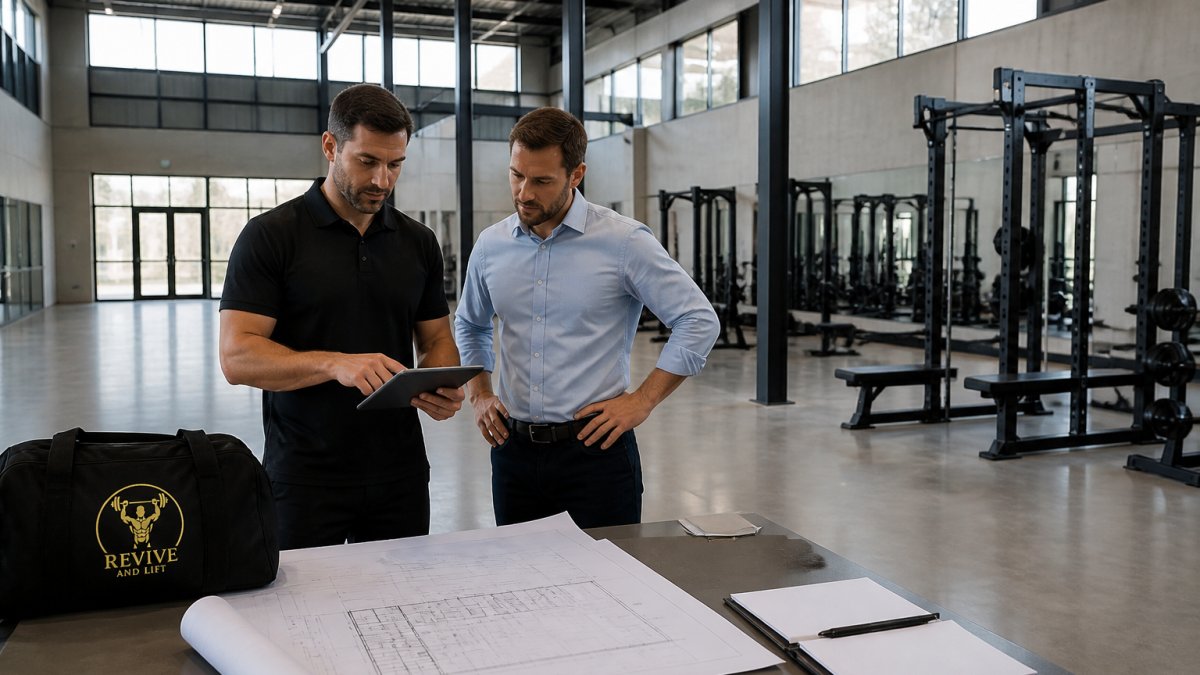
Commercial gym design services translate your space into a layout, and that layout determines what you can actually buy. A quote built without a floor plan is a guess.
Space Planning and Floor Plans
A floor plan confirms the equipment mix fits, positions high-traffic pieces away from walkways, and gives suppliers exact quantities to price.
Start with circulation. Strength equipment needs clearance around racks and benches for spotting and loading; cardio needs room behind for mounting and dismounting; functional trainers need open floor space in front.
Then map your zones: a typical layout separates strength, cardio, and functional training areas, with storage at the edges.
Step-by-Step Fitness Equipment Procurement Process
The fitness equipment procurement process runs from site assessment to final delivery in five stages, each producing a document the next depends on. What most guides leave out is the comparison layer between receiving bids and signing a contract, where the real savings and risk live. Navigating these procurement complexities ensures that your facility investment remains as scalable and efficient as the principles outlined in our home gym setup guide.
From Site Assessment to Final Delivery
Step 1: Site assessment. Measure the space, check floor loading, confirm ceiling heights, and document the delivery path.
Step 2: Equipment specification. Decide your equipment mix by training style and user count.
Step 4: Bid comparison. Normalize each quote against your template, then compare on total cost of ownership rather than purchase price alone.
Step 5: Order and installation. Confirm lead times, schedule delivery around your buildout, and lock in assembly and installation dates.
| Stage | What You Produce | Typical Duration |
|---|---|---|
| Site assessment | Measurements and photos | 1-2 days |
| Equipment specification | Itemized equipment list | 3-7 days |
| Quote request | Template sent to suppliers | 1 day |
| Bid comparison | Normalized comparison sheet | 1-2 weeks |
| Order and installation | Signed contract, delivery schedule | Varies by lead time |
A Quote Comparison Framework Most Buyers Skip
Getting quotes is easy; comparing them fairly is where projects are won or lost. Build a single comparison sheet with one row per line item and one column per bidder, then score each bid on these dimensions:
- Line-item parity. Confirm every bidder priced the same make, model, quantity, and specification. A bid that substitutes a lighter-gauge rack or residential-grade treadmill isn't a lower price, it's a different product.
- Freight and delivery. Ask whether freight is included, whether it's curbside or inside delivery, and who pays for liftgate service or a shuttle truck if the site can't take a full trailer.
- Assembly and installation. Clarify whether the price includes uncrating, assembly, anchoring, and debris removal, or just drop-off, one of the largest hidden gaps between bids.
Score each bid 1-5 per dimension, then weight what matters most: a hard opening date should weight lead time heavily, a tight capital budget should weight payment terms.
Total Cost of Ownership Beyond the Purchase Price
Total cost of ownership is the purchase price plus freight, assembly, installation, warranty value, preventative maintenance, and expected service life. Two bids identical on the equipment list can differ substantially once these are added.
A few mechanics worth understanding:
- Preventative maintenance. Commercial cardio typically needs belt and deck inspection, lubrication, and eventual belt replacement; strength equipment needs periodic inspection of cables, bushings, and fasteners. Skipping it means higher repair costs and shorter equipment life.
- Energy consumption. Cardio machines with large consoles and motors draw more power than strength equipment, which draws essentially none. In a room with dozens of treadmills, energy use is a real operating line item over years.
- Service life. Commercial-grade equipment is built for higher duty cycles than residential, which is why the upfront price is higher. The relevant question is cost per year of service, not cost at purchase.
A bid that includes installation and a full manufacturer warranty is frequently the better value even when the line-item price is higher. The gap between purchase price and total cost is where most facility budgets go wrong.
Space Optimization and Revenue per Square Foot
Equipment density isn't just a layout question, it's a financial one. In a membership or fee-based facility, every square foot either generates revenue or sits idle.
That math justifies higher-end equipment.
When comparing quotes, ask each bidder to show the footprint of their proposed package.
Commercial Half Rack with Storage System | TKO →
Requesting a Custom Quote: What Suppliers Need From You
A custom quote request should give suppliers four things: the space, the list, the services, and the deadline. Miss one and you'll get a padded number or a follow-up email instead of a price.
Here's what to send:
- Dimensions and photos of the room, including ceiling height and access route
- Itemized equipment list by category, with quantities and any brand preferences
- Service scope: white glove delivery, assembly, and installation, or drop-off only
Sharing a budget range isn't a weakness in negotiation, it lets suppliers propose a package that fits rather than quoting a dream build you'll never approve.
Comparing Quotes: A Framework for Total Cost of Ownership
Total cost of ownership is the purchase price plus delivery, assembly, installation, warranty value, and expected maintenance over the equipment's service life. Quotes that look cheapest up front often aren't.
Use this framework to compare bids:
- Normalize the equipment list. Confirm every bidder priced the same items, quantities, and specifications.
- Add service costs. Delivery, assembly, and installation vary widely between suppliers.
- Score warranty coverage. Compare what's covered, for how long, and who handles claims.
- Estimate maintenance. Commercial-grade equipment in a high-intensity environment needs preventative maintenance.
- Check the lead time. A cheaper bid that arrives two months late can cost more than the difference.
A bid that includes installation and a full manufacturer warranty is frequently the better value even when the line-item price is higher. The gap between purchase price and total cost is where most facility budgets go wrong.
Financing, Leasing, and Package Pricing Options
Financing and leasing spread the cost of a commercial buildout over time, while package pricing bundles equipment and services into a single quoted figure. Which fits depends on your cash position, how long you plan to keep the equipment, and how you weigh total cost of ownership against monthly cash flow.
How the Three Structures Differ
Financing is a loan or installment agreement that ends with you owning the equipment. Payments are typically fixed, and because you own the asset, you may capture depreciation benefits depending on your entity structure.
Leasing is a rental or lease agreement for a defined term, with the equipment returning to the lessor at the end.
Package pricing bundles equipment and services into a single quoted figure rather than pricing each item separately.
Comparing Financing and Leasing on Total Cost
The monthly payment is the least useful number in a financing or leasing comparison. What matters is total cost across the full term, including fees, residual or purchase-option value, and what happens at term end.
Build a comparison that captures:
- Total payments across the term. Multiply the monthly figure by the number of months, then add upfront or origination costs.
- End-of-term position. With financing, you own the equipment. With leasing, you return it, renew, or exercise a purchase option, each with a different cost implication.
- Maintenance responsibility. Confirm who handles preventative maintenance and repairs during the term. Some leases shift this to the lessee.
Package Pricing and Space Optimization ROI
Package pricing is where space optimization and total cost of ownership intersect.
Consider the TKO 921HR-STRG Commercial Half Rack with Storage, which integrates a storage bay directly into the rack footprint. Combining lifting and storage reduces clutter and eliminates separate storage racks, changing the math on floor space and total equipment count.

When evaluating package pricing, ask each bidder to show the footprint of their proposed package alongside the itemized price.
Revive and Lift works with commercial buyers on both financing and package pricing questions, and can help you structure a quote request that makes the comparison straightforward. IRS guidance on Section 179 expensing for business equipment
Conclusion: Your Next Steps for a Successful Quote Request
The facilities that get clean quotes did the boring work first: measured the space, mapped the layout, and wrote a template every supplier could answer.
Revive and Lift supports that process end to end. We're an authorized dealer for brands including TKO Strength & Performance, York Barbell, Defiant Strength, and Ecore, so every product carries a full manufacturer warranty.
Send us your floor plan and equipment list, and we'll help you turn it into a quote you can compare with confidence.
Frequently Asked Questions
What information is needed for a commercial gym equipment quote?
To get an accurate quote, provide your facility dimensions, floor plan, intended use (e.g., strength training, cardio, functional fitness), number of users, budget range, and any preferred brands. Include details about electrical and HVAC capabilities. A site assessment may be required for large projects. The more specific your gym equipment quote template, the faster and more precise the response.
How long does it take to receive a commercial gym equipment project quote?
Timelines vary by project complexity. Simple quotes for standard equipment can be returned within 1-2 business days. Custom projects involving facility design, site visits, and multiple equipment types may take 1-2 weeks. Providing a complete gym equipment quote template upfront helps speed up the process. Always ask for an estimated turnaround when you submit your request.
Should I request quotes from multiple fitness equipment suppliers?
Yes, getting multiple quotes is standard practice. It helps you compare pricing, warranty coverage, lead times, and service offerings. However, focus on total cost of ownership, not just the lowest price. A supplier that offers commercial gym design services, installation, and preventative maintenance may provide better long-term value. Use our quote comparison framework to evaluate each proposal fairly.
What factors influence the cost of a commercial gym outfitting project?
Key cost drivers include equipment type and quantity, brand tier, customization, shipping logistics, installation services, and financing terms. Facility size and layout also affect costs, especially if you need commercial gym design services. Always request a detailed breakdown to understand where your budget is allocated and identify potential savings through package pricing.


