

Last Updated: November 3, 2026
Quick Summary
The best gym flooring for boutique strength studios matches each zone's load, format, and noise demands, using dense rubber thick enough for dropped weights. Plan by zone before ordering: thickest rubber under platforms, mid-thickness roll on open lifting floors, and thinner surfaces in stretching corners.
- Rubber rolls suit fixed lifting floors, while interlocking tiles fit flexible layouts, rentals, and easy repairs.
- Thinner 6mm to 8mm surfaces handle cardio and light dumbbell work; thicker options add shock absorption for strength training.
- A layered assembly of resilient base, rigid platform, and rubber wear surface protects the subfloor better than a single mat.
- Set maintenance by zone: daily sweeping, weekly pH-neutral mopping, monthly seam inspection, and quarterly edge checks.
- Buy flooring last is a common mistake; measure the room and map zones before ordering.
Table of Contents
- Why Boutique Strength Studios Need Purpose-Built Gym Flooring
- Rubber Gym Flooring Rolls vs Tiles: Which Format Fits Your Studio Layout?
- Gym Flooring Thickness for Weights: Matching Specs to Your Training Loads
- The Best Flooring for Weightlifting: Comparing Rubber Options Side by Side
- How to Protect Your Subfloor and Manage Noise in a Strength Studio
- Gym Flooring Maintenance: Cleaning, Inspecting, and Planning for Replacement
- Choosing Your Gym Flooring: A Zone-by-Zone Decision Framework
- Planning Your Boutique Studio Flooring Purchase with Revive and Lift
- Frequently Asked Questions
Why Boutique Strength Studios Need Purpose-Built Gym Flooring
Choosing the best gym flooring for boutique strength studios is a decision that touches every session your members train. Studio owners typically weigh three things at once: protecting the subfloor and building, protecting the lifter, and protecting the look of a space clients pay to be in. Generic carpet or bare concrete fails on all three.
A boutique strength studio is a specific animal. It runs small-group barbell classes, one-on-one coaching, and open lifting hours in a room that may sit above a neighbor or beside a yoga studio. That mix puts unique demands on the floor: heavy weight drops in one corner, sled pushes in another, and a room that needs to stay quiet and presentable between sessions.
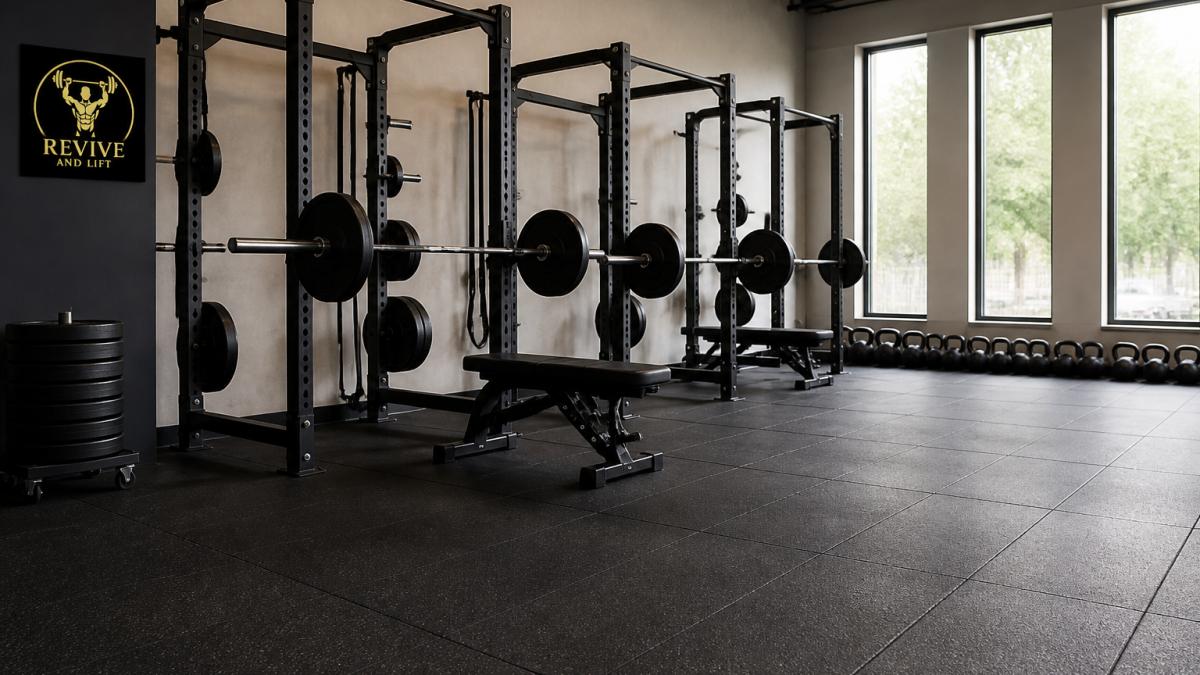
Rubber is the standard for a reason. It absorbs impact, holds traction under chalk and sweat, and stands up to daily commercial traffic. The real question is which rubber, in what thickness, and in what format. Below, we break down exactly how to choose.
Rubber Gym Flooring Rolls vs Tiles: Which Format Fits Your Studio Layout?
The choice between rubber gym flooring rolls and interlocking tiles comes down to layout. Rolls give you a seamless surface with fewer edges to catch. Tiles give you flexibility to reconfigure, replace single damaged pieces, and install without adhesive over existing floors.
Rolls suit a fixed, open lifting floor where the racks and platforms will not move. Tiles suit a studio that shifts between class formats or rents a space where permanent installation is off the table. If tiles fit your plan better, view the interlocking rubber tiles to compare.
| Format | Best For | Trade-off |
|---|---|---|
| Rubber rolls | Fixed lifting floors, seamless look | Harder to reconfigure later |
| Interlocking tiles | Flexible layouts, rentals, repairs | More seams and edges |
| Roll-out mats | Temporary or portable zones | Limited coverage area |
A common mistake is ordering tiles for a room where the racks never move. You pay for flexibility you will not use and inherit seams that collect chalk dust. Match the format to how the room actually operates.
Gym Flooring Thickness for Weights: Matching Specs to Your Training Loads
Gym flooring thickness for weights should match your heaviest regular load, not your lightest. Thin flooring under a deadlift platform will compress and fail. Overbuilding a stretching corner wastes budget you could put into equipment.
As a working rule, thinner surfaces in the 6mm to 8mm range handle cardio, functional training, and light dumbbell work. Mid-range products around 7.5mm to 10.5mm add more shock absorption for strength and conditioning.
Force reduction ratings tell you how much impact a surface absorbs. A 10.5mm product in the Ecore Performance line carries a force reduction rating of 23.9%, while the 6mm Ecore Fit roll sits at 10.4%. Higher force reduction means a softer, more forgiving surface underfoot. Lower numbers mean a firmer, more responsive feel. Neither is "better" in the abstract; each fits a different zone.
The Best Flooring for Weightlifting: Comparing Rubber Options Side by Side
The best flooring for weightlifting is a dense rubber surface thick enough to absorb dropped loads and stable enough that a loaded barbell does not sink. Within rubber, the differences come down to construction and thickness.
Vulcanized rubber products bond layers together, which produces a durable surface. Recycled composition rubber uses reclaimed material. Both belong in a strength studio; the split is usually budget and load.
Here is how our rubber options compare:
| Product | Thickness | Force Reduction | Price per sq ft |
|---|---|---|---|
| Ecore Fit Rolled Rubber | 6mm | 10.4% | $2.76 |
| Ecore Fit Rolled Rubber | 8mm | 10.4% | $2.93 |
| Ecore Fit Interlocking Tiles | 8mm | 10.4% | $4.15 |
| Ecore Performance Vulcanized | 7.5mm | 12.6% | $6.35 |
| Ecore Performance Vulcanized | 10.5mm | 23.9% | $8.64 |
For a dedicated platform, a thicker vulcanized product such as the 10.5mm option above gives you more material between the bar and the slab. For open floor and cardio, the Fit roll keeps costs down without giving up traction.
How to Protect Your Subfloor and Manage Noise in a Strength Studio
Subfloor protection and noise control are the two costs studio owners underestimate most. Dropped weights send vibration through the slab and into the structure. In a multi-tenant building or a studio above retail, that vibration becomes a complaint, and in a boutique studio with back-to-back classes, it becomes a complaint every hour.
Start with the mechanism. A dropped barbell releases energy in two directions: downward into the floor assembly and outward as airborne sound. That is why the assembly matters as much as the surface.
A layered assembly does more than a single mat. The common pattern in boutique strength studios is a resilient rubber base, a rigid platform layer over the lifting zone, and a rubber wear surface on top. Each layer has a job: the base decouples the platform from the slab, the platform spreads point loads from rack feet and dropped bars, and the wear surface provides traction and impact absorption. A single 8mm roll over concrete protects the surface but does little to interrupt vibration transmission.
Watch out: a platform that sits directly on the slab with no resilient layer underneath will transmit nearly all impact vibration into the structure, no matter how thick the rubber on top is.
Treat acoustic performance as a starting point, not a guarantee, the actual result depends on the slab, the ceiling assembly below, and how the platform is built. If your building has a structural engineer or landlord review, confirm the floor assembly meets their requirements before you buy, and ask whether they require an underlayment or isolation pad beneath the platform.
6mm Rolled Rubber Flooring | Ecore Fit →
Seams and edges are the quiet failure points. An unsealed seam lets chalk dust and moisture work under the surface, and a lifted edge becomes a trip hazard and a noise leak. Seal perimeter edges against the wall and butt seams tightly; on a roll, a straight seam that opens over time is a sign the subfloor was not flat when it was installed.
What most guides miss: noise complaints rarely come from the drop itself. They come from vibration traveling through the structure for hours of class. Address the transmission, not just the thud, and plan the assembly before the racks arrive, because retrofitting isolation under a loaded platform is far more disruptive than building it in from the start.
Gym Flooring Maintenance: Cleaning, Inspecting, and Planning for Replacement
Gym flooring maintenance is simple but not optional. Regular sweeping, damp mopping, and inspection of seams and edges help keep rubber surfaces in good condition.
Most guides stop at the cleaning list. The part that actually protects a boutique studio's budget is the inspection cadence and the replacement plan, because flooring fails unevenly, one platform takes most of the abuse while the cardio corner looks new for years.
Set a cadence by zone rather than by room:
- Daily: sweep the platform zone and walkways; spot-mop sweat and chalk.
- Weekly: damp mop the full floor with a pH-neutral cleaner; never use harsh solvents, which dry out rubber and dull the surface.
- Monthly: inspect platform edges, the front of each rack, and high-traffic walkways for loose seams, lifted tile corners, and compressed spots.
- Quarterly: check perimeter edges against the wall and the transition strips at doorways; these are where moisture and trip hazards start.
In a studio where one platform takes all the abuse, that difference compounds over the floor's life.
Plan for replacement from day one. Lifecycle cost is not only the sticker price; it also includes the cost of repairs along the way.
Finally, tie maintenance to the class schedule. A studio that runs back-to-back barbell classes generates more chalk and grit in a week than a home gym does in a year. Build the sweep into the turnover between classes and the monthly inspection into the manager's checklist, and the floor will outlast the equipment on top of it.
Choosing Your Gym Flooring: A Zone-by-Zone Decision Framework
Planning by zone rather than by room can help match each area to the right surface. Common zones include a platform area, an open lifting floor, and a stretching or recovery corner.
Use this framework:
- Platform zone: thickest, densest rubber for dropped loads
- Open lifting floor: mid-thickness roll for stability and traction
- Functional turf strip: turf over a rubber base for sled work
- Stretching corner: thinner rubber or matting for comfort
- Walkways: durable roll that matches the main floor
Get the floor and the equipment plan aligned before you order either. For the strength stations themselves, see our commercial strength training equipment sets buyer's guide.
A common mistake is buying flooring last, after the racks arrive. Measure the room, map the zones, then order.
Planning Your Boutique Studio Flooring Purchase with Revive and Lift
The best gym flooring for boutique strength studios is the surface that matches each zone's load, format, and noise demands, ordered in the right quantity the first time. That takes a plan, not a guess.
We help studio owners build that plan. Our catalog carries Ecore athletic flooring across the Fit and Performance lines, with roll and tile formats in multiple thicknesses. Commercial buyers can contact us for help planning purchases and requesting a project quote. Financing and nationwide white glove delivery and assembly are also available.
Get started with Revive and Lift to plan a strength studio floor.
Frequently Asked Questions
What is the best flooring for a strength training studio?
Vulcanized rubber flooring is the standard for strength studios because it handles heavy foot traffic, resists wear, and provides slip resistance. For a boutique studio, choose a thickness based on your heaviest lifts: 6mm to 8mm works for cardio and light strength areas, while 10.5mm or thicker is better for free-weight zones where weights are dropped. Ecore Fit and Ecore Performance collections offer commercial-grade options that balance impact absorption with energy return.
How thick should rubber flooring be for a commercial gym?
Thickness depends on the training zone. For cardio and functional training, 6mm to 8mm rolled rubber is common. For free-weight areas with dumbbells and barbells, 8mm to 10.5mm provides more shock absorption. In spaces where heavy weights are dropped from overhead, thicker rubber (10.5mm or more) or additional matting under platforms is recommended. Always check the force reduction rating: higher percentages mean more impact absorption.
Is rolled rubber or rubber tile better for a boutique fitness studio?
Rolled rubber offers fewer seams and a cleaner look, making it ideal for large open areas and strength zones. Rubber tiles are easier to install, replace, and reconfigure, which suits studios that change layouts or need to access subfloors. For a boutique studio with a fixed layout, rolls provide a seamless surface; for rental spaces or frequent updates, interlocking tiles offer flexibility. Both formats from Ecore Fit deliver the same 10.4% force reduction.
How do you clean and maintain commercial gym flooring?
Sweep or vacuum regularly to remove debris, and clean spills promptly. Inspect seams and edges periodically. Plan for replacement in high-traffic zones based on wear patterns.


