

Table of Contents
- What Belongs in a Commercial Strength Training Equipment Set
- Commercial Gym Equipment Packages: What to Compare Before You Buy
- How to Layout a Commercial Strength Training Area
- Durability, Safety Standards, and Regulatory Compliance
- Best Practices for Gym Equipment Maintenance and Lifecycle Management
- Choosing the Right Commercial Strength Equipment for Your Facility
- Frequently Asked Questions
Last Updated: September 22, 2026
What Belongs in a Commercial Strength Training Equipment Set
Commercial strength training equipment sets are coordinated groups of machines and free-weight stations built for continuous use in a shared facility, rather than a single piece bought for a garage. At Revive and Lift, we help gym owners, studio operators, and facility managers assemble these sets so every station earns its floor space. Most buyers start with the category mix before they compare brands.
Selectorized, Plate-Loaded, and Multi-Station Options
Selectorized machines use a weight stack with a pin, so users change resistance in seconds. They suit beginner-heavy floors, circuit training, and any setting where speed of transition matters.
| Option | Setup Speed | Space Needed | Best For |
|---|---|---|---|
| Selectorized | Fast | Moderate | Beginner floors, circuits |
| Plate-loaded | Slower | Moderate to large | Experienced lifters |
| Multi-station | Fast | Small | Studios, multifamily gyms |
| Free weights | Slowest | Large | Powerlifting, athletics |
Commercial Gym Equipment Packages: What to Compare Before You Buy
Comparing commercial gym equipment packages means looking past the invoice. Two quotes for the same room can differ by thousands once delivery, assembly, flooring, and service access enter the picture. Facility managers who compare only the sticker price usually pay for it later.
Here is what belongs in a side-by-side comparison:
- Frame gauge and weld quality. Thicker steel and full welds hold up under daily commercial use. Ask for the load capacity rating on every rack and bench.
- Upholstery and finish. Commercial-grade vinyl and powder-coated finish resist sweat, chalk, and cleaning chemicals. Thin padding tears within a year on a busy floor.
- Warranty terms. Compare frame, parts, and labor coverage separately. A long frame warranty with a short parts warranty tells you where the maker expects failures.
- Service access. Confirm that replacement cables, pads, and weight stack components can be ordered without long lead times.
- Delivery and installation. Ask whether assembly is included or billed separately.
Total Cost of Ownership Beyond the Sticker Price
Total cost of ownership is the full cost of a piece of equipment across its service life, including purchase, delivery, assembly, flooring, maintenance, parts, and eventual replacement. Buyers who ignore it often find that the cheaper set costs more by year three.
Budget for these line items before you sign:
- Purchase price per station
- Freight and white-glove installation
- Rubber flooring and any subfloor prep
- Annual maintenance and replacement parts
- Staff time for cleaning and inspection
How to Layout a Commercial Strength Training Area
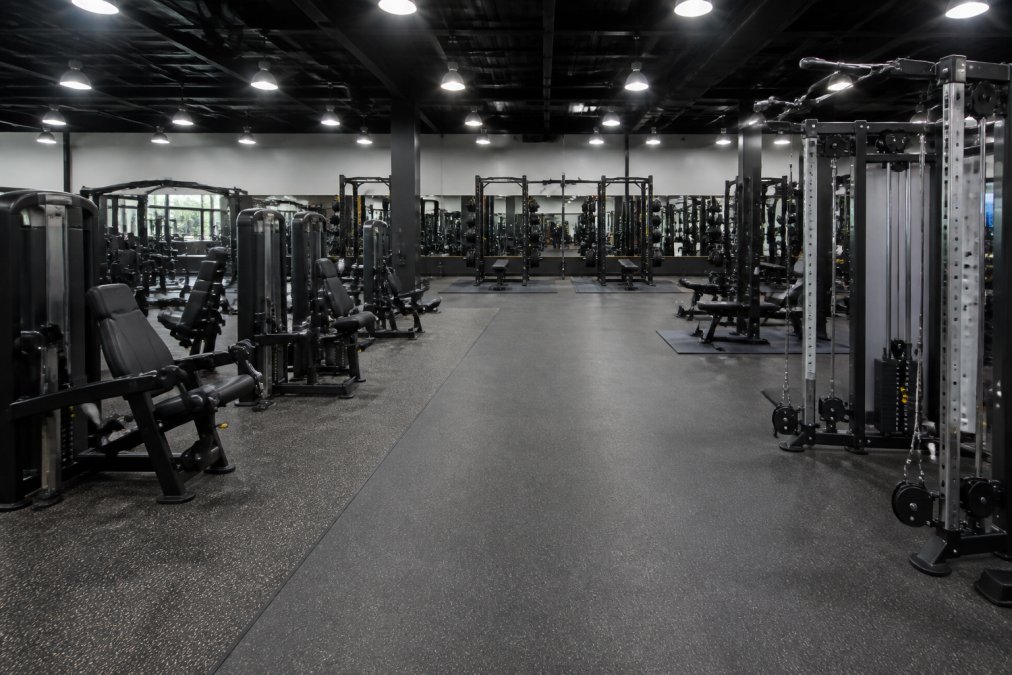
Laying out a commercial strength training area starts with movement paths, not equipment lists. Map how members walk in, warm up, lift, and exit, then place stations along those paths. Equipment that blocks a walkway gets moved, and moved equipment gets damaged.
Start With Clearance Math, Not a Wish List
The single most common layout failure is ordering equipment before measuring the room. Work through these steps in order:
- Measure the room and mark columns, doors, and ceiling height. Overhead clearance decides where a power rack or squat rack can go. A standard power rack needs roughly 8 feet of ceiling height to allow a standing press inside the frame; a squat stand needs less because the lifter steps out.
- Zone the floor. Group free weights together, machines together, and functional training in its own area. Mixing zones forces members to carry plates across traffic.
- Apply working clearances, not just equipment footprints. A selectorized machine may occupy a 4-by-6-foot footprint, but it needs roughly 36 inches of clear working space on the user side and enough room behind the seat for a user to step away from a loaded weight stack. A power rack needs 3 to 4 feet of clear space on the loading side and enough depth in front for a lifter to bail out of a failed squat.
- Place mirrors and cable crossover units on perimeter walls. They free up the center of the room and give members a sightline to check form.
- Leave a straight path from the entrance to the cardio area. Members should never weave through a lifting zone to reach a treadmill.
Equipment-Specific Spacing Rules
Clearances are not one-size-fits-all. A few rules of thumb that hold up across most commercial floors:
- Dumbbell racks: leave 3 to 4 feet of clear space in front so members can step back and rack weights without colliding with the next user.
- Olympic platforms: allow at least 8 feet by 8 feet per platform, plus buffer space between platforms for dropped bars.
- Cable crossover stations: need roughly 4 feet of clear space on the working side and enough width for the cable arms to travel without striking a wall.
- Selectorized circuits: align machines so users move in one direction, which reduces collisions and speeds up transitions during peak hours.
Space Efficiency Comes From Zone Discipline
A room with clear zones holds more usable stations than a room packed edge to edge. The instinct to fill every square foot backfires because members avoid crowded zones, and equipment in tight quarters gets bumped, scraped, and knocked out of alignment. A common pattern is that facilities which plan for circulation first end up with more revenue-generating stations than those that maximize machine count.
Plan for Growth and Reconfiguration
Few facilities get the layout right on the first try. Leave one or two zones with room to expand, and keep power and data runs accessible along perimeter walls so you can add a station without trenching flooring. Equipment that is bolted down should be bolted where you are confident it will stay for years; everything else benefits from being movable.
Durability, Safety Standards, and Regulatory Compliance
Durability and safety are the two specifications that separate commercial grade equipment from home units. A home bench might see three sessions a week; a commercial bench in a multifamily fitness center can see thirty. Commercial-grade frames, heavier upholstery, and sealed bearings are built for that duty cycle.
What "Commercial Grade" Actually Means
"Commercial grade" is a marketing term, not a regulated one. Buyers who want to verify durability should ask for specific specifications rather than accepting the label:
- Steel gauge and wall thickness. Heavier-gauge tubing resists flex under load. Ask for the wall thickness in the frame, not just the tube diameter.
- Weld type and inspection. Full-penetration welds on load-bearing joints outperform spot welds. Ask whether the manufacturer performs weld inspection and whether documentation is available.
- Load ratings. Every rack, bench, and cable station should carry a published maximum user weight and, for racks, a maximum load rating. If a supplier cannot produce these numbers, treat that as a red flag.
- Duty cycle rating. Some manufacturers publish an intended use classification (for example, light commercial versus full commercial). Match the rating to your actual traffic.
Safety Standards and What They Cover
The ASTM standards for fitness equipment cover test methods and design requirements for stationary strength equipment, including structural integrity, stability, and entrapment hazards. These are voluntary consensus standards, but they are widely referenced in product liability cases and by insurers, so compliance is effectively a commercial expectation even where it is not a legal mandate.
A Compliance Checklist You Can Actually Use
What this means in practice:
- Ask suppliers for documentation showing equipment meets recognized test standards, and keep that documentation on file.
- Keep an inspection log for cables, welds, fasteners, and upholstery, with dates and initials.
- Post weight limits and usage instructions at each station, in a location members actually see.
- Verify walkways and transfer space meet accessibility rules before you bolt anything down.
- Check with your insurer about whether they require specific standards compliance or inspection records for coverage.
- Train staff on what to look for during daily walkthroughs, so problems are caught before they become incidents.
Ergonomics and User Safety
Compliance is a floor, not a ceiling. Ergonomics determines whether members actually use the equipment safely. Adjustable seats, properly positioned pivot points, and clear start-and-finish positions reduce the chance of strain injuries. When you evaluate a set, sit on the machines and run through the range of motion yourself. If a station feels awkward to you, it will feel worse to a member who is new to strength training.
Best Practices for Gym Equipment Maintenance and Lifecycle Management
Best practices for gym equipment maintenance come down to a simple schedule: inspect often, clean daily, and replace on a timeline rather than on failure. Equipment lifecycle management means planning for replacement before a machine becomes unsafe or unusable.
| Task | Frequency | Who Handles It |
|---|---|---|
| Wipe down upholstery and handles | Daily | Floor staff |
| Inspect cables, belts, and fasteners | Weekly | Floor staff |
| Lubricate guide rods and check weight stacks | Monthly | Maintenance tech |
| Deep clean pads and tighten frames | Quarterly | Maintenance tech |
| Full safety audit and parts review | Annually | Facility manager |
Choosing the Right Commercial Strength Equipment for Your Facility
Choosing the right commercial strength training equipment sets depends on who trains in your space and how often. A boutique studio with small classes needs different equipment than a corporate wellness room serving fifty employees on lunch breaks.
Match the facility to the set:
- Multifamily housing fitness rooms: multi-station units, selectorized machines, and adjustable benches. Prioritize space efficiency and low-maintenance designs.
- Boutique training studios: plate-loaded racks, cable crossover stations, and functional training tools for small-group work.
- Schools and universities: heavy-duty power racks, platform space, and durable free weights built for high traffic.
- Corporate wellness facilities: a balanced mix of selectorized and cardio-adjacent strength stations that suit short sessions.
Frequently Asked Questions
What is the best brand for commercial strength training equipment?
There is no single best brand because the right choice depends on your facility type, training style, and budget. Brands like TKO Strength & Performance, York Barbell, and Defiant Strength are trusted names in commercial strength equipment. What matters more is buying from an authorized dealer that carries genuine products with full manufacturer warranties. Counterfeit and gray-market equipment often fails early and carries no warranty support.
What is the average cost of commercial strength training equipment sets?
Pricing for commercial strength training equipment sets depends on how many stations you need, whether you choose selectorized or plate-loaded machines, and the brand tier. A single multi-station unit costs far less than a full facility package. Because every facility has different space and user needs, the most accurate approach is to request a project quote based on your equipment list and floor plan.
What are the safety standards for commercial gym equipment?
In the U.S., commercial strength equipment should meet ASTM International standards for fitness equipment design and testing, and facilities must comply with ADA accessibility requirements for path-of-travel and accessible stations. Your facility should also follow OSHA guidelines for workplace safety if the gym serves employees. Always verify that equipment ships with documented compliance and load capacity ratings.
How do I choose the right strength training equipment for a small studio?
Start by mapping your floor plan and measuring clearances for each machine, including the space a user needs to mount, load, and exit safely. Multi-station and cable crossover units deliver the most exercise variety per square foot. Functional training tools like adjustable benches and power racks add versatility without a large footprint. For small studios, white-glove installation helps maximize usable space because the assembly team can position equipment for the tightest efficient layout.
Outfitting a facility is a long-term capital decision, and the wrong set costs you twice: once at purchase and again at replacement. Revive and Lift helps you get it right the first time, with commercial-grade equipment, financing through Affirm and Shop Pay, full manufacturer warranties, and white-glove delivery and assembly from a team that plans fitness spaces for a living. Get started with Revive and Lift and build a strength floor that holds up to daily use.


