

Table of Contents
- What to Know Before Buying Commercial Weight Lifting Racks
- Commercial Strength Training Equipment Sets: Storage and Space
- TKO Commercial Racks with Integrated Storage
- York Barbell STS Commercial Racks: Versatility and Value
- Anatomy Fitness TORGYN Power Rack V2: Full-Cage Performance
- Gym Equipment Safety Standards and ASTM Compliance
- Maintenance, Inspection, and Total Cost of Ownership
- How to Choose the Right Rack for Your Facility
- Frequently Asked Questions
Last Updated: September 28, 2026
What to Know Before Buying Commercial Weight Lifting Racks
Choosing the right commercial weight lifting racks requires understanding the difference between power cages and half racks, the materials that withstand daily heavy use, and how safety features protect your athletes. The equipment you select will shape your facility's training capacity for years, so getting it right matters.
This guide from Revive and Lift breaks down the critical specs, safety standards, and real-world considerations that separate a solid investment from one that fails under load.
Power Racks vs. Half Racks for Commercial Use
A power rack is a fully enclosed cage with four uprights, while a half rack features two uprights and one open side. The choice depends on your facility's footprint, the exercises you prioritize, and your budget.

Power racks provide a complete safety envelope. They work best for facilities running structured strength programs where multiple athletes train simultaneously. The enclosed design lets lifters bail safely on failed squats or bench presses without the bar rolling away. Half racks save floor space and work well for facilities that emphasize unilateral movements, landmine work, or where space is constrained.
According to research from the American College of Sports Medicine, commercial facilities managing high-volume training benefit from equipment that accommodates multiple body types and movement patterns without repositioning between sets. That's where rack design becomes critical. Power racks handle this better if you're running group classes or team training. Half racks excel in boutique studios where personalization and space efficiency matter more.
The footprint difference is substantial. A full power rack occupies roughly 80 square feet including clearance. A half rack with integrated storage can fit in 50 square feet. For facilities with under 3,000 square feet, half racks often make more sense. For larger commercial gyms or collegiate weight rooms, power racks justify the extra space.
Heavy-Duty Steel Construction and Durability
Commercial racks must handle hundreds of lifts per day without flex, noise, or degradation. The gauge of steel and welding quality determine how long the equipment lasts.
Look for 3x3 inch uprights made from 11-gauge steel or heavier. This thickness resists bending under load and provides the stability athletes need during maximal efforts. Laser-cut numbering on uprights allows fast, precise adjustments without guessing or fumbling between sets.
Polyurethane-lined contact points protect barbells from chipping and reduce the metal-on-metal noise that echoes through a gym. These liners are replaceable, so equipment stays quiet even after years of use.
Commercial Strength Training Equipment Sets: Storage and Space
Integrated storage transforms how efficiently a facility operates. When weights live on the rack itself, athletes don't waste time hunting for plates or dumbbells between sets.
Integrated Storage Systems
Storage shelves built into the rack structure save floor space and improve organization. Kettlebell shelves, dumbbell holders, and plate storage racks can all be configured on either side of the lifting area, turning the equipment footprint into a complete training station.
Customizable shelf options let you match your equipment mix. A facility heavy on kettlebell training configures shelves differently than one focused on barbell work. This modularity means the rack grows with your program without requiring additional purchases.
The best integrated systems keep equipment at eye level and within arm's reach. Athletes grab what they need without breaking focus.
Footprint and Floor Loading Requirements
Before purchasing, verify your facility can support the equipment's weight. Commercial racks range from 800 to 1,300 pounds depending on whether storage is included. A dual-rack system with annex storage can exceed 1,300 pounds.
Floor loading capacity matters most in multifamily residential buildings or facilities on upper levels. Standard commercial flooring rated for 100+ pounds per square foot handles most racks without reinforcement. Verify with your facility manager or structural engineer if you're uncertain.
The footprint also determines how many racks fit your space. A single half rack requires roughly 65 inches of length and 120 inches of width. A dual half-rack system with annex storage stretches to 166 inches wide. Measure your available space and account for clearance on all sides. Athletes need room to load and unload barbells, move around the rack, and bail safely if needed.

TKO Commercial Racks with Integrated Storage
TKO Strength & Performance builds racks specifically for commercial environments. Their 3x3 uprights and integrated storage systems reduce the total footprint while maximizing training capacity.
Commercial Half Rack with Storage →
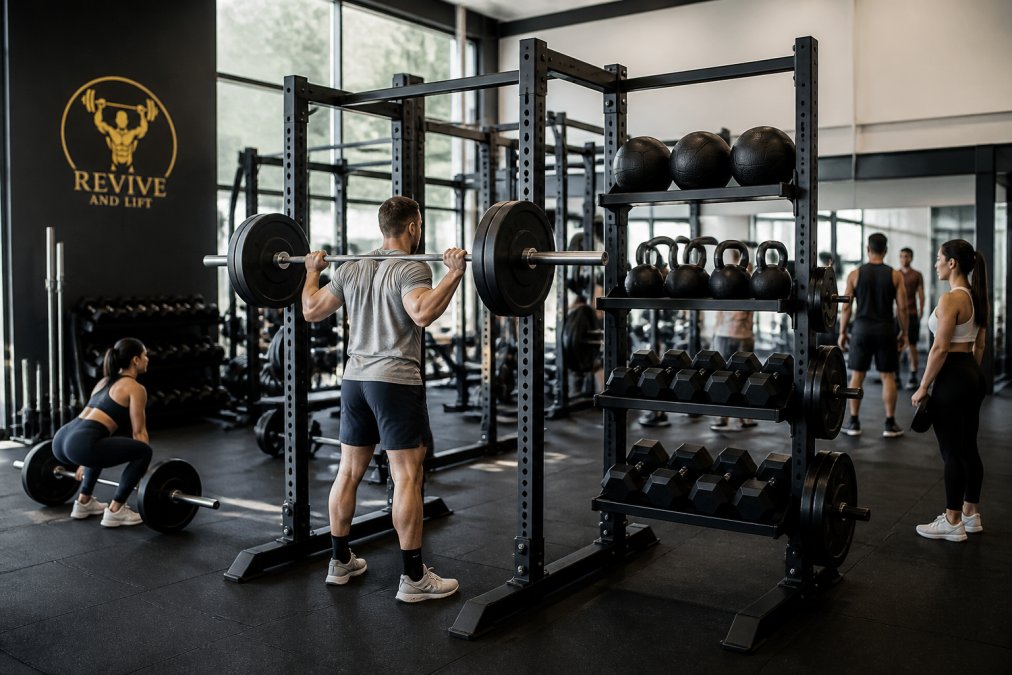
The TKO 921HR-STRG Half Rack with Storage combines a half rack with a dedicated storage bay configured on either side. This design eliminates the need for separate storage units, which saves money and floor space. The storage can hold kettlebells, dumbbells, bumper plates, or medicine balls depending on your program. Laser-cut numbering makes adjustments fast, and polyurethane-lined J-cups protect bars from wear.
For facilities needing more capacity, the TKO 921HR-ANX Dual Half Power Rack System includes two racks connected by an integrated annex. The annex adds a pull-up bar and high-capacity storage, turning the space between racks into a functional training zone instead of wasted floor area. This system works well for boutique studios or performance centers where multiple athletes train in the same area.
The TKO 920PR-STRG Power Rack with Storage brings the same integrated design to a full-cage power rack. This is ideal for facilities running structured strength programs where a complete safety envelope matters. The 3x3 steel construction handles heavy daily use, and the customizable storage keeps equipment organized without expanding the footprint.

For larger facilities, the TKO 920PR-ANX Dual Power Rack System with Storage combines two full power racks with integrated annex storage and a pull-up bar. This setup supports high-volume training environments and collegiate weight rooms where multiple athletes train simultaneously.
York Barbell STS Commercial Racks: Versatility and Value
York Barbell's STS line delivers commercial-grade construction at a lower price point than some competitors. These racks feature adjustable hook plates, integrated weight storage, and pull-up bars standard on most models.
The York Barbell STS Commercial Power Rack includes a combo grip pull-up bar, 19 adjustable positions spaced at 3-inch increments, and scuff-resistant weight storage pegs. The 42-inch interior width provides ample room for squats and bench presses. This rack works for serious lifters and professional gyms that need durability without integrated storage complexity.
The York Barbell STS Commercial Half Power Rack delivers the same durability in a space-efficient design.
Anatomy Fitness TORGYN Power Rack V2: Full-Cage Performance
The TORGYN Power Rack V2 by Anatomy Fitness is a full commercial power rack built for serious lifting environments. It features heavy-duty steel construction, an integrated pull-up bar, and built-in plate storage pegs.
Gym Equipment Safety Standards and ASTM Compliance
Commercial strength equipment must meet ASTM International standards, which define safety requirements for free weights and weight machines. These standards ensure equipment can handle the loads and movements athletes put on it.
Maintenance, Inspection, and Total Cost of Ownership
All products come with full manufacturer warranties.
The lifespan of a well-maintained commercial rack is 10-15 years or longer. This long service life means the annual cost is relatively low compared to equipment that requires replacement every 5 years. A rack costing several thousand dollars amortized over 12 years is a reasonable facility expense.
How to Choose the Right Rack for Your Facility
Start by measuring your available space and verifying floor capacity. Then consider your training philosophy and athlete needs.
| Rack Type | Best For | Footprint | Starting Price |
|---|---|---|---|
| Half Rack with Storage | Space-efficient facilities, boutique studios | 65" L × 120" W | $2,249-$4,436 |
| Power Rack with Storage | High-volume training, group classes | 65" L × 166" W | $4,676 |
| Dual Rack Systems | Large facilities, collegiate weight rooms | 86-166" W | $6,854-$7,334 |
| Compact Models | Budget-conscious buyers, home gyms | 48-67" L | $1,299-$2,349 |
Frequently Asked Questions
What's the difference between a power rack and a half rack for commercial use?
A power rack (full cage) provides four uprights and complete safety coverage on all sides, ideal for facilities with space and multiple lifters. A half rack uses two uprights and is best for squats, presses, and rows where lifters face one direction. Half racks save floor space while power racks offer more exercise versatility and accommodate multiple training styles simultaneously. Choose based on your facility's footprint, member count, and planned exercises.
What weight capacity should a commercial weight lifting rack have?
Commercial racks should support at least 1,000 lbs of dynamic load capacity to handle heavy barbell training safely. Most commercial-grade racks meet or exceed this standard. Consider your member base: serious powerlifters and strength athletes require higher capacity ratings. Check the manufacturer's specifications for both the frame and individual components like J-cups and safety arms to ensure consistent durability across the entire system.
Are commercial weight lifting racks required to meet ASTM safety standards?
While ASTM International publishes voluntary standards for fitness equipment, most commercial facilities follow ASTM F3101-19 guidelines for strength training equipment. These standards address stability, durability, safety features like spotter arms, and structural integrity. Reputable commercial racks from established manufacturers are engineered to meet or exceed these standards. Always verify compliance with the manufacturer and confirm that your equipment includes proper safety features like locked J-cups and secure spotting arms.
How much floor space does a commercial weight lifting rack need?
A half rack typically requires 48-65 inches of length and 67 inches of width, while a full power rack needs 73-86 inches of length and 67 inches of width. Plan for additional clearance around the rack for safe loading, unloading, and movement. If installing multiple racks or adding storage, measure your facility carefully and account for walkways and equipment access. Many commercial facilities bolt racks to the floor for stability, which requires structural assessment before installation.
What maintenance do commercial weight lifting racks require?
Inspect racks monthly for loose bolts, rust, or wear on J-cups and safety arms. Wipe down powder-coated surfaces regularly to prevent corrosion. Check polyurethane linings for damage and replace if worn. Tighten all fasteners seasonally or after heavy use. Keep moving parts lubricated lightly if applicable. Document inspections to track wear patterns. Professional white-glove installation services can include setup guidance and initial inspection protocols to extend rack lifespan in high-volume facilities.


