

Table of Contents
- Quick Comparison: Top Home Gym Flooring Picks
- What to Look For in Home Gym Flooring
- Rubber vs. Foam: Which Wins for a Home Gym?
- How to Install Home Gym Flooring: Step-by-Step
- Protecting Subfloors in Home Gyms
- Maintenance, Noise, and Long-Term Performance
- Conclusion
- Frequently Asked Questions
Last Updated: September 30, 2026
Quick Comparison: Top Home Gym Flooring Picks
Finding the best gym flooring for home use comes down to matching material, thickness, and installation method to how you actually train. At Revive and Lift, the same questions come up: rubber or foam, tiles or mats, and how much thickness is enough.
Here's the short version before the detail:
| Pick | Material | Thickness | Best For |
|---|---|---|---|
| Ecore Fit Rubber Interlocking Tiles | Recycled vulcanized rubber | 8 mm | Full-room coverage, cardio plus strength |
| Ecore Vulcanized Rubber Smash Mat | Vulcanized rubber | 9.5 mm | Portable lifting and functional work |
| Ecore Gym Equipment and Exercise Mats | Rubber | 1/4 in | Under cardio machines and bikes |
| Anatomy Fitness Standalone Lifting Platform | Bamboo, rubber, recycled cotton | Multi-layer | Olympic lifting and deadlifts |
What to Look For in Home Gym Flooring
The best gym flooring for home use balances shock absorption, stability under load, moisture resistance, and installation effort.

Material Types and How They Perform
Rubber flooring is the standard for weight rooms because it absorbs impact without compressing under a loaded barbell. Foam is lighter and warmer underfoot but dents under heavy static loads and tears at seams. Vinyl and rubber roll-out mats suit cardio zones where you want a seamless surface.
Gym Flooring Thickness Guide: Matching Depth to Your Training
Thickness should follow your heaviest activity, not your lightest:
- Under 6 mm: Light cardio and stretching only. Not suitable for dropped weights.
- 6-10 mm: Cardio equipment, dumbbells, functional training, and moderate free weights.
- 10-20 mm: Home strength training with controlled barbell work.
- Dedicated platform: Olympic lifting, deadlifts, and repeated barbell drops.
The Ecore Smash Mat sits at 9.5 mm, handling repeated heavy impacts while staying portable. For a full room, 8 mm interlocking tiles cover cardio and strength in one continuous surface.

Rubber vs. Foam: Which Wins for a Home Gym?
Rubber wins for anything involving heavy weight: barbells, dumbbells over 20 pounds, or equipment with a metal base.
Where foam still makes sense:
- Bodyweight and mobility work in a spare bedroom
- Temporary setups where you need to roll the surface away
- Budget-first builds where no weights will be dropped
Where foam fails:
- Dumbbells left on the surface leave permanent dents
- Seams separate under repeated foot traffic
- Moisture trapped underneath promotes odor and mold
How to Install Home Gym Flooring: Step-by-Step
Most interlocking rubber tile installations take a single afternoon in a standard two-car garage or spare room. These steps assume a clean, empty space and address the subfloor and layout problems that trip people up.
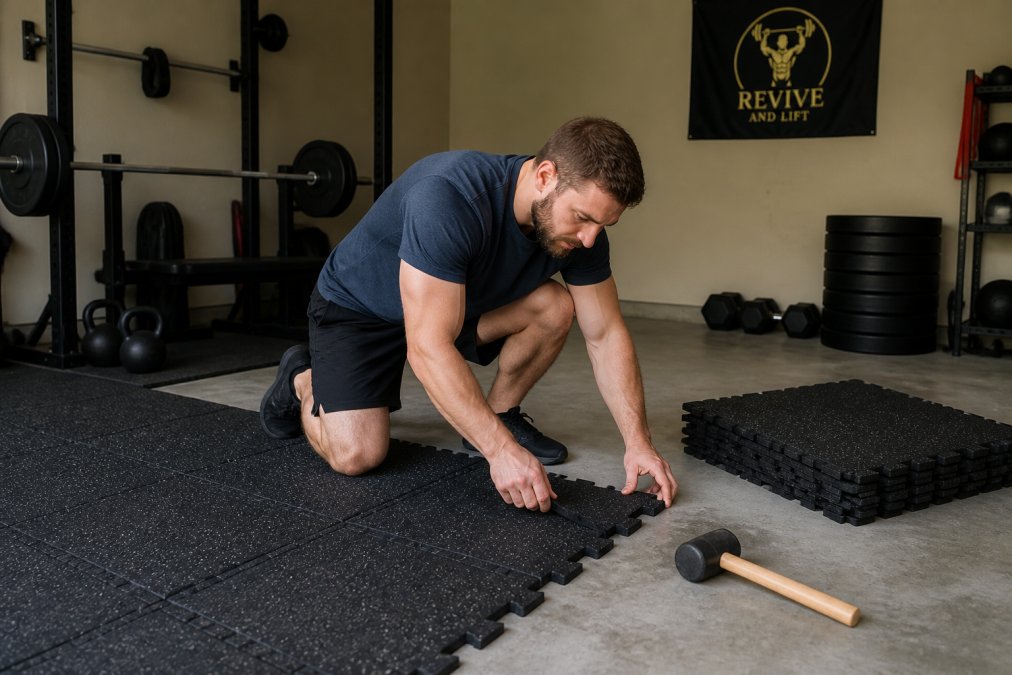
What you'll need:
- Interlocking rubber tiles or roll-out mats
- Utility knife with fresh blades and a straight edge
- Rubber mallet
- Tape measure and chalk line
- Vapor barrier (for concrete subfloors)
- Knee pads
- Jigsaw or oscillating multi-tool (for cutting around pillars and door casings)
Subfloor Compatibility and Preparation
Subfloor type changes the prep work, not the flooring choice.
Floor Load Capacity Above Ground Level
A loaded barbell plus a platform plus a lifter concentrates a lot of weight in a small area. A 300-pound barbell on a 4-foot-by-8-foot platform spreads that load, but a dropped deadlift briefly multiplies it. On an upper floor, check with a structural professional before installing a heavy setup; on a ground-level slab, this is rarely a concern. Because a dropped deadlift can send a sharp impact through the floor even when the static load is manageable, Glory and Power Enterprises connects this concern with practical ways to reduce gym floor impact.
8mm Rubber Interlocking Tiles | Ecore →
Cutting Around Pillars, Posts, and Irregular Corners
The step-by-step above assumes a rectangular room. Real spaces have lally columns, door casings, and angled walls. Here's how to handle them without wasting tiles.
- Measure twice, cut once. For a pillar, measure from the nearest laid tile edge to each face, transfer to a tile, and cut with a jigsaw or multi-tool. A utility knife handles straight cuts but struggles on inside corners.
- Use a paper template for odd shapes. Trace the obstacle onto cardboard, test-fit, then transfer to the tile, faster than measuring complex angles.
- Leave a 1/4-inch expansion gap at every fixed object. Tiles expand and contract with temperature; butting them tight against a pillar or wall causes buckling.
- Plan the layout from the most visible wall. Start your chalk line along the wall you see first when you walk in, and push cut tiles to the least visible edges.
Protecting Subfloors in Home Gyms
Protecting subfloors in home gyms comes down to three layers: a moisture barrier, a cushioning layer, and a wear layer.
Maintenance, Noise, and Long-Term Performance
Maintenance is where rubber flooring earns its reputation: sweep or vacuum weekly, damp mop with a neutral cleaner, and skip anything abrasive. Noise control and material safety are where the real decisions get made.
Acoustic and Vibration Dampening for Shared Spaces
If your gym shares a wall or floor with living space, noise and vibration matter as much as thickness.
A practical pattern for apartment and upper-floor setups:
- Layer, don't just thicken. A 3/4-inch rubber tile over a 1/2-inch shock-absorbing base outperforms a single 1-inch tile for vibration control.
- Isolate the platform. A standalone lifting platform with a separate base decouples the impact from the floor better than wall-to-wall tile.
- Cover the full footprint. Partial coverage leaves hard floor exposed where vibration can still transfer.
- Check your lease or HOA rules first. Many multi-unit buildings restrict dropped weights regardless of flooring. Knowing the rule before you buy saves a return.
Off-Gassing and Material Safety
Vulcanized composition rubber, used in Ecore Fit tiles and the Smash Mat, is reclaimed rubber bonded under heat and pressure. It typically has a milder, shorter-lived odor than crumb rubber held together with a binder, because vulcanization locks in more volatile compounds.

What to do about it:
- Ventilate before use. Unbox the flooring in the garage or a covered outdoor area for a few days if weather allows, then install and run a fan or open windows for another few days.
- Warmth accelerates off-gassing. A warm room releases volatiles faster, so the smell fades sooner in a heated space than a cold one.
- Ask for material disclosures. Reputable manufacturers publish what's in the product. Reclaimed content and clear binder information are good signs.
- Sensitivity varies. If you're sensitive to chemical odors or the gym is in a bedroom, choose vulcanized rubber or a low-odor foam and ventilate thoroughly before regular use.
Long-Term Performance and Durability
Two failure modes to watch for over the years:
- Compression set, permanent dents under equipment feet or a parked barbell. Denser rubber resists this; foam and low-density crumb rubber don't.
- Edge curl, tiles lifting at the perimeter, usually from moisture underneath or from butting tiles tight against a wall without an expansion gap.
Conclusion
Getting the flooring right is the step most home gym builders rush, and the hardest to undo later. Match thickness to your heaviest lift, put a barrier between rubber and concrete, and choose density over cushion.
Frequently Asked Questions
What is the best flooring material for a home gym?
Rubber remains the top choice for most home gyms because it handles dropped weights, resists moisture, and holds up under heavy equipment. Vulcanized composition rubber tiles like the Ecore Fit 8mm tiles offer a balance of impact absorption and stability. Foam works for bodyweight and yoga areas but compresses under heavy loads. If you lift heavy, rubber or a dedicated lifting platform is the safer long-term investment.
How thick should home gym flooring be for heavy lifting?
For general strength training with dumbbells and moderate weights, 8mm rubber tiles provide adequate protection. If you drop barbells or do Olympic lifts, you need more. A dedicated lifting platform with a shock-absorbing base, like the Anatomy Fitness Standalone Platform, is built specifically for repeated heavy impacts. The platform's multi-layer construction includes armor-coated rubber and a recycled-cotton base that absorbs vibration and protects the floor underneath.
Do I need to glue down rubber gym mats?
Interlocking rubber tiles typically do not require adhesive. The Ecore Fit 8mm tiles lock together and stay in place under their own weight and the weight of equipment. Portable mats like the Ecore Smash Mat or Gym Equipment Mats sit on top of your existing floor with no installation at all. Adhesive is only needed for rolled rubber in permanent commercial installations or when tiles are placed in high-traffic areas where shifting is a concern.
Can mold grow under rubber flooring?
Mold needs moisture, warmth, and organic material to grow. Rubber itself does not feed mold, but trapped moisture between the flooring and a concrete subfloor can create conditions for it. To prevent this, test your concrete slab for moisture before installation, use a moisture barrier if needed, and avoid installing rubber directly over damp concrete. In most finished indoor spaces with normal humidity, mold under rubber flooring is not a common problem.
Is EVA foam or rubber better for a gym floor?
Foam and rubber serve different purposes. EVA foam is lighter, cheaper, and comfortable for floor exercises, stretching, and bodyweight work. It compresses permanently under heavy equipment and tears when dragged across. Rubber handles weight plate impact, resists slipping when sweaty, and does not compress over time. For a home gym with free weights or machines, rubber is the more durable choice. Foam can work as a secondary layer for yoga or mat work on top of rubber.


