

Last Updated: November 10, 2026
Quick Summary
Percussion massage can reduce post-exercise soreness and temporarily improve range of motion and how the muscle feels and moves. Research shows modest short-term effects, so treat it as one part of a recovery routine alongside sleep, nutrition, and progressive loading, not a treatment for injury.
- Use the device for 1 to 2 minutes per muscle group, rarely more than 10 to 15 minutes per session.
- Keep the head on muscle tissue and avoid bones, joints, the spine, and the front and sides of the neck.
- Track soreness on a 0-10 scale and range of motion for a few weeks to see if it helps you.
- Percussion complements foam rolling and stretching rather than replacing them in a recovery routine.
- Anyone pregnant, on blood thinners, or with a bleeding disorder should consult a clinician before use.
Table of Contents
- What Percussion Massage Does for Muscle Recovery
- The Benefits of Massage Gun on Sore Muscles
- How Long to Use a Massage Gun for Recovery
- Personalized Protocols by Muscle Group and Training Context
- Massage Gun Safety Guidelines and When to Avoid It
- Percussion Massage Compared With Other Recovery Methods
- Choosing a Percussion Massager for Your Recovery Space
- Frequently Asked Questions
What Percussion Massage Does for Muscle Recovery
Percussion massage is a form of mechanical soft tissue stimulation in which a handheld device delivers rapid, repetitive pulses into a targeted muscle. At Revive and Lift, we field questions about it constantly from people building home gyms and recovery spaces. Research points to a few short-term effects on muscle recovery, including possible reductions in post-exercise soreness and temporary improvements in how the muscle feels and moves. It is a recovery tool, not a treatment for injury.
How Percussive Therapy Works on Soft Tissue
The device head strikes the muscle surface many times per second. That rapid percussion sends mechanical stimulation through the soft tissue and, according to Cleveland Clinic's overview of massage guns, is thought to influence blood flow and the nervous system's signaling. In practice, this means two things. First, the tissue warms and loosens. Second, the nervous system gets a strong sensory input that many people describe as relaxing rather than painful.
What the Clinical Evidence Actually Shows
Honest framing matters here. Research on percussive therapy is still developing, and most studies look at short-term effects in small groups. A PubMed review of vibration and percussion therapy research points to potential short-term reductions in soreness and stiffness, but the effect sizes are modest and the evidence base is not yet strong enough to promise dramatic outcomes. Treat a massage gun as one useful piece of a recovery routine, not a cure.
It helps to sort the claims into two buckets. The short-term outcomes most often discussed are reduced soreness after exercise, a temporary increase in range of motion, and a perceived easing of muscle tension, which many users notice within minutes to a day and which may fade if the tool is not used consistently. Claims about faster tissue healing, improved strength or power, and long-term performance gains have thinner support. Percussion massage should not be treated as a replacement for sleep, nutrition, and progressive loading. A realistic expectation is that percussion makes the recovery window more comfortable and may help you move through it, not that it shortens the window itself.
How to Tell Whether It Is Helping You
Because individual response varies, the practical move is to track your own data rather than rely on marketing claims. A simple log works: rate soreness on a 0-10 scale each morning, note range of motion on a specific movement (for example, how far you can reach toward your toes or how deep you can squat), and record training readiness before each session. Use percussion consistently for a few weeks, then compare. If soreness ratings drop and mobility improves without a change in training load, that is a reasonable personal indication the tool suits you. If nothing changes, it may not be worth the time, and that is useful information too. Keep the log simple and avoid changing multiple recovery variables at once, or you will not know what caused the difference.
Watch out: short-term changes in soreness or mobility do not necessarily mean faster tissue healing, improved strength, or better long-term performance. Do not use a good-feeling session as a reason to skip rest days or push through pain.
The Benefits of Massage Gun on Sore Muscles
Ask anyone who trains hard and they will tell you the same thing: the day after a heavy session is when a recovery tool earns its keep. The benefits of massage gun use on sore muscles come down to a handful of practical, short-term effects that most users notice within a session or two.
Reduced DOMS and Post-Exercise Soreness
Delayed onset muscle soreness, or DOMS, is the ache that peaks a day or two after unfamiliar or intense exercise (pubmed.ncbi.nlm.nih.gov). A common approach is a short percussion session on the sore area, which some people find eases the discomfort. It does not erase soreness.
Better Range of Motion, Flexibility, and Circulation
Loosening a tight muscle before stretching often helps you get further into the position. Percussion may support that warm-up effect. For flexibility and mobility work, a brief pass over the target muscle before you stretch is a simple habit that pays off.
How Long to Use a Massage Gun for Recovery
The practical answer for how long to use a massage gun for recovery is 1 to 2 minutes per muscle group, and rarely more than 10 to 15 minutes in a single session. Move the head slowly across the muscle rather than holding it in one spot. The Lunix LX25 includes an adjustable 10-30 minute session timer. More time is not better; consistent, moderate use is.
| Context | Duration per muscle | Frequency |
|---|---|---|
| Post-workout soreness | 1-2 minutes | Once daily |
| Pre-workout warm-up | 30-60 seconds | Before training |
| Desk-bound tension | 1-2 minutes | As needed |
| Deep tension, large muscle | 2-3 minutes | Once or twice daily |
Personalized Protocols by Muscle Group and Training Context
A single setting does not suit every muscle. Large groups like the thighs and back tolerate broader, firmer contact, while the calves, shoulders, and arms respond better to lighter pressure and more precise heads. Before training, keep sessions brief and light to prime the tissue; after training, a slightly longer, gentler pass supports relaxation. Integrating these mechanical pulses with the restorative wavelengths detailed in our red light therapy guide creates a comprehensive approach to managing systemic inflammation and tissue repair.
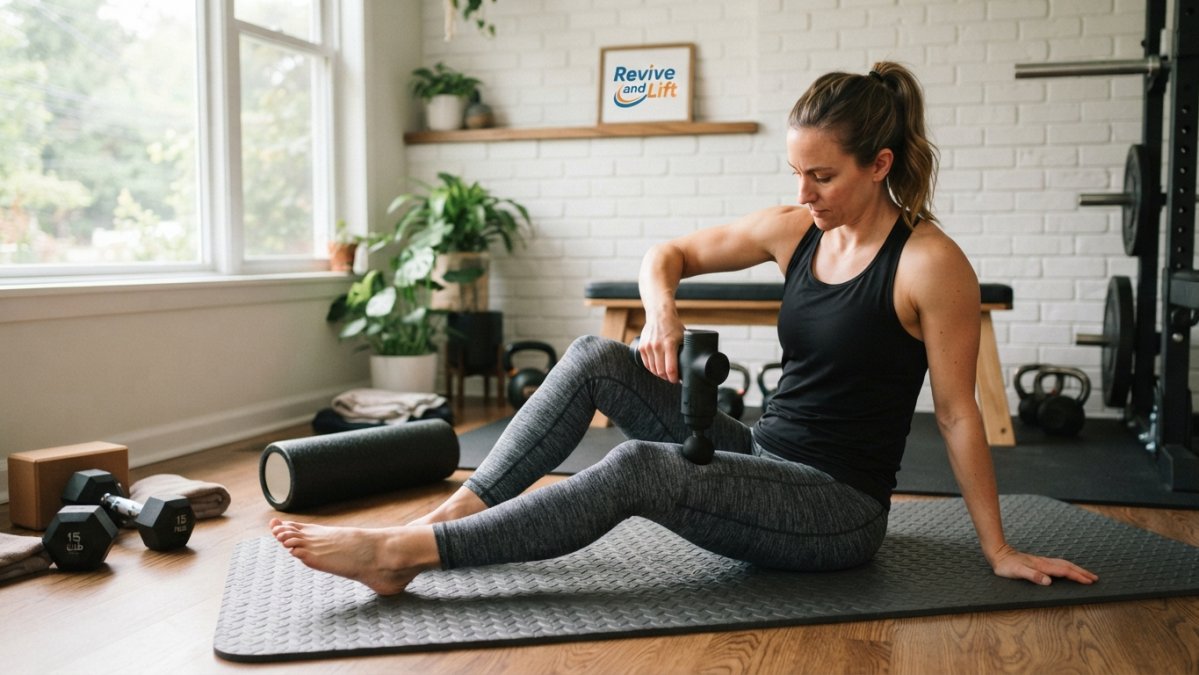
The woman is American.
Context changes the protocol too. A runner recovering from a long effort will want more time on the calves and hamstrings; a lifter may focus on the shoulders and upper back. If you are outfitting a compact space, our guide to compact recovery tools for home gyms shows how to fit a massage gun and other recovery gear into a small footprint without clutter.
Massage Gun Safety Guidelines and When to Avoid It
Massage gun safety guidelines are simple but non-negotiable. Keep the device on muscle tissue, avoid bones, joints, and the spine, and do not use it on an area that is bruised, swollen, or injured. Stop if it causes sharp pain rather than a dull, pleasant pressure.
Areas to Avoid
Certain regions are off-limits regardless of how good the device feels. Skip the front and sides of the neck, where major blood vessels and nerves sit close to the surface. Avoid the spine itself and the area directly over the kidneys. Do not apply percussion over the shins, collarbones, or other spots where bone lies just under the skin. Keep the head away from the eyes, the groin, and any area with varicose veins or visible vascular changes.
Contraindications and When to Seek Clinical Advice
Some conditions make percussion massage a poor choice without a clinician's sign-off, including open wounds, recent fractures or surgery, and bruising or swelling of unknown cause. Anyone who uses blood thinners, has a bleeding disorder, is pregnant, or has a history of blood clots or a condition affecting nerves or blood vessels should speak with a healthcare provider before use.
Red Flags That Mean Stop
Stop using the device and seek clinical advice if you notice sharp or shooting pain, persistent numbness or tingling, unusual bruising, or swelling that worsens. If you have an injury you have not had assessed, treat the massage gun as something to avoid until a professional weighs in.
This section is general guidance, not medical advice. When in doubt, ask a qualified clinician who knows your history before you start.
Percussion Massage Compared With Other Recovery Methods
Percussion sits alongside foam rolling, static stretching, and active recovery rather than replacing them. Foam rolling covers broad areas with body weight; a massage gun reaches specific points and hard-to-reach spots like the upper back. Stretching builds flexibility, and easy movement supports circulation. A sensible routine mixes them. For a wider view of how percussion fits with the equipment athletes rely on, see our guide to essential recovery equipment for athletes.
Choosing a Percussion Massager for Your Recovery Space
Match the device to the muscles you train and the space you have. A four-head model like the Lunix LX25 covers a broader muscle area and adds red and near-infrared light, while a compact deep tissue gun like the LX28 is cordless and easy to carry for self-massage on the go. You can browse recovery tools to compare formats, or look at the 4-Head Percussion Massager and the Deep Tissue Massage Gun directly. Our products are backed by full manufacturer warranties.


Building a recovery routine that actually gets used takes the right tool for your space and your training. Revive and Lift carries hand-selected recovery equipment, offers flexible financing, and provides white glove delivery and assembly so your setup is ready to use. Get started with Revive and Lift and give your muscles the recovery support they deserve.
Frequently Asked Questions
Do massage guns actually speed up muscle recovery?
The evidence points to modest, mostly short-term help rather than a dramatic speed-up. Some research on percussion massage reports reduced soreness and stiffness after exercise. What the research does not show is a large effect on long-term recovery or performance. Think of a massage gun as one useful tool in a recovery routine that also includes sleep, nutrition, and adequate rest between sessions.
When should you not use a percussion massager?
Skip percussion massage over open wounds, recent fractures, bruises, or areas that are swollen and hot. Avoid it over the spine and the front of the neck. Do not use one if you have a bleeding disorder or are on blood thinners without first checking with a healthcare provider. If pain is sharp or persistent, see a clinician before self-treating.
How long should you use a massage gun on a specific muscle group?
A common suggestion is about 30 seconds to 2 minutes per muscle group at a low-to-moderate setting, moving the head slowly rather than holding it in one spot. Large groups like the thighs or back can take a little longer, while smaller areas like the calves or forearms need less. Stop if you feel numbness, tingling, or sharp pain. A session of 5 to 10 minutes total is usually enough for post-workout recovery.
Is percussion massage safe for post-workout recovery?
Percussion massage is generally used on muscle tissue at a comfortable intensity and avoided over joints and bones. Start on the lowest setting and increase gradually. If you are new to it, keep sessions short and check how you feel the next day. Anyone with an injury, a medical condition, or who is pregnant should check with a healthcare provider first.


